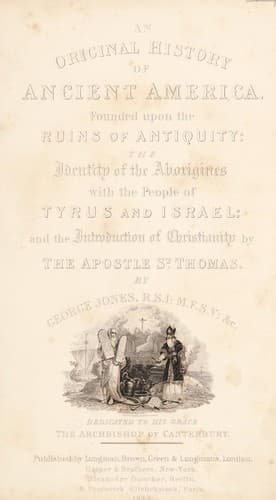
The History of Ancient America, Anterior to the Time of Columbus: Proving the Identity of the Aborigines with the Tyrians and Israelites; and the Introduction of Christianity into the Western Hemisphere By The Apostle St. ThomasJones, George
History
The History of Ancient America, Anterior to the Time of Columbus: Proving the Identity of the Aborigines with the Tyrians and Israelites; and the Introduction of Christianity into the Western Hemisphere By The Apostle St. Thomas
Jones, George
America -- Antiquities; America -- Discovery and exploration -- Phoenician; Indians -- Origin
ITHOBALUS THE SECOND--TO SISINNES.
THE FIRST SIEGE OF TYRUS, &c.--FULFILMENT OF THE PROPHECY BY
JEREMIAH AND EZEKIEL,--AND OF THE FIRST AND SECOND PROPHECY BY
ISAIAH.
During the war upon Egypt by the King of Babylon, (and which occurred
only seven years after the Voyage around Africa,) it is probable that
the King of Tyrus would assist Pharaoh-Necho against the invasion of
the Nile by Nebuchadnezzar. The attack by Pharaoh, at the solicitation
of Judæa [Ezekiel xvii. 15], (which nation was still paying the annual
tribute to Egypt,) had compelled the Babylonian to raise the siege of
Jerusalem:--in this movement, also, the Tyrians may have aided by
countenance or wealth. In these apparent probabilities, we find the
_political_ cause why Nebuchadnezzar turned his fury upon Tyrus,
after his conquest of Egypt, and his second and successful invasion of
Judæa, and the captivity of the Jews,--which latter event took place
588 B. C.
The fall of Judæa gave the monopolizing and pride-stricken Tyrians
great cause for rejoicing,--not from malice against the afflicted
People,--but because their own _Trading_ propensities would be
increased,--as it would (in their minds) by the downfall of any
aspiring Nation. A few years before they had witnessed the conquest of
Egypt,--and now of Judæa,--both of which were causes of peculiar joy
to the Tyrians; for those Nations had latent sparks within them, from
which the fire of Science might be created, and so illumine their own
path towards the attainment of Navigation, and thence rest upon their
own exertions for Commercial prosperity. Jerusalem had evinced this
spirit as early as the time of SOLOMON,--and also Egypt, only seven
years before her present downfall. This was the point causing the
National rejoicing of Tyrus;--it was a Commercial gladness,--thence
(with them) a _political_ one:--less rejoicing, or its entire absence,
would have been "love of neighbour,"--and which, when it affected
their interest, the Tyrians never had;--extended joy,--as if Jerusalem
had fallen for the express purpose of their own prosperity, and so
sanctioned by their Gods,--became blasphemy! They evinced this impiety
to its full extent;--therefore, the King of Babylon, in resenting his
own wrongs, was but an instrument of retribution in the hand of GOD,
to punish those, who in savage triumph rejoiced at the chastening,
and captivity of a neighbour-Nation.
EZEKIEL thus describes the _Religious_ cause why Tyrus (in her want of
charity to a fallen neighbour) should become desolate. [xxvi.] He
prophesied, 588 B. C.,
"The word of the LORD came unto me, saying, Son of Man, _because_ that
Tyrus hath said against Jerusalem, 'Aha! she is broken that was the
gates of the People: she is turned unto _me_; I shall be replenished,
now _she_ is laid waste!'"--
The Prince of Tyrus, also, uttered this blasphemy in his triumph:--
"I am a God! I sit in the seat of God!" [xxviii.]
Public-domain text, read in full here on John Shaqi.
Reviews
Reviews
No reviews yet
Be the first to share your thoughts on this work.
Elsewhere in the archive
Join the Discussion
Join the discussion
Sign in to leave a comment or review.
Sign InorCreate an account