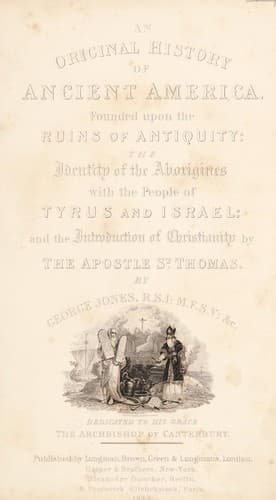
The History of Ancient America, Anterior to the Time of Columbus: Proving the Identity of the Aborigines with the Tyrians and Israelites; and the Introduction of Christianity into the Western Hemisphere By The Apostle St. ThomasJones, George
History
The History of Ancient America, Anterior to the Time of Columbus: Proving the Identity of the Aborigines with the Tyrians and Israelites; and the Introduction of Christianity into the Western Hemisphere By The Apostle St. Thomas
Jones, George
America -- Antiquities; America -- Discovery and exploration -- Phoenician; Indians -- Origin
"Therefore," continues EZEKIEL, "thus saith the LORD GOD: Behold, I am
against thee, O Tyrus, and will cause many Nations to come up against
thee, as the Sea causeth his waves to come up. And they shall destroy
the walls of Tyrus, and break down her towers: I will scrape her dust
from her and make her like the top of a rock. _It shall be a place for
the spreading of nets in the midst of the Sea_; [how truly fulfilled!]
for I have spoken it, saith the LORD GOD: and it shall become a spoil
to the Nations. And her daughters which are in the field shall be
slain with the sword; and they shall know that I am the LORD. For thus
saith the LORD GOD:--Behold I will bring upon Tyrus Nebuchadnezzar
king of Babylon, a King of Kings, from the north, with horses, and
with chariots, and with horsemen, and companies, and much people,"
&c.
The remaining part of the Prophecy is not required,--the cause is
shewn,--the punishment and the avenger. The Prophecy was uttered by
EZEKIEL in the year in which Jerusalem was destroyed (the Temple of
which the Tyrians of a former age had erected and adorned), and
consequently three years before the commencement of the Siege of Tyrus
by the Babylonian. The doom of Tyrus was also foretold by ISAIAH and
JEREMIAH; and by the former, that the Nation should cease for _seventy
years_. He prophesied one hundred and twenty-seven years, and JEREMIAH
twenty-one years before the Siege by the King of Babylon. It was
strictly fulfilled. The investment commenced in the reign of Ithobalus
[_i. e._ Eth-baal] the Second, and lasted _thirteen_ years--the
longest Siege on record. Troy was only _ten_; the Roman Siege of Veii,
by Camillus, occupied the same period.
It has already been shewn, upon the authority of ISAIAH and EZEKIEL,
that the _Island_ of Tyrus must have been partly inhabited, for they
distinctly allude to the "Isle." The metropolis proper, with its
Temples and splendour, was on the mainland,--and this was the _City_
besieged by the Conqueror of Egypt and Judæa. The Island he could not
reach from the want of Galleys; his force consisting of Chariots,
Cavalry, and Infantry. It was impossible, therefore, to take Tyrus
(one side being on the Sea) as he had captured Jerusalem, through the
terrific means of Famine,--the horrors of which are so powerfully
depicted in the Lamentations of JEREMIAH; and in reference to Judæa,
foretold by the first Lawgiver nearly nine centuries before!
The Tyrians, through the means of their shipping, continually supplied
the Capital with provisions,--thence the duration of the Siege, and
Nebuchadnezzar had not the genius of the subsequent and final
Conqueror of Tyrus--the heroic Macedonian.
Public-domain text, read in full here on John Shaqi.
Reviews
Reviews
No reviews yet
Be the first to share your thoughts on this work.
Elsewhere in the archive
Join the Discussion
Join the discussion
Sign in to leave a comment or review.
Sign InorCreate an account