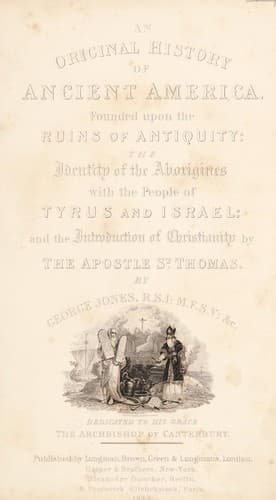
The History of Ancient America, Anterior to the Time of Columbus: Proving the Identity of the Aborigines with the Tyrians and Israelites; and the Introduction of Christianity into the Western Hemisphere By The Apostle St. ThomasJones, George
History
The History of Ancient America, Anterior to the Time of Columbus: Proving the Identity of the Aborigines with the Tyrians and Israelites; and the Introduction of Christianity into the Western Hemisphere By The Apostle St. Thomas
Jones, George
America -- Antiquities; America -- Discovery and exploration -- Phoenician; Indians -- Origin
515 B. C.] The Second Temple was finished and dedicated in the year
515 before Christ. Now taking the Prophecy of ISAIAH, to commence at
the _beginning_ of the Siege of Tyrus (for Tyrus had then ceased to be
free, _i. e._ as a Nation), which was in 585 B. C., the "seventy
years" will be _exactly accomplished_ at the dedication of the Second
Temple.
Thus were the first and second Prophecies by ISAIAH fulfilled,--viz.,
the fall and subsequent freedom,--for the destruction did take place,
and at the termination of "seventy years" the Lord of Mercy _did_
"visit Tyrus," and made her again a Nation;--for her scorn and boast
upon the destruction of Jerusalem had been forgotten and forgiven, in
her stretching forth her hand again to aid the building of the Sacred
Temple to The One and Only GOD!
As an instance of Divine Justice, it may be observed, that the freedom
of Tyrus did not take place _before_ the restoration of Judæa,--and
that the former nation had to endure the remorse of knowing that the
latter from her new throne of liberty, could behold the manacles of
thraldom upon that country, which (in prosperity) had shouted in
impious triumph upon _her_ desolation!
CHAPTER VIII:
(515--335 B. C.)
SISINNES TO STRATO.
AND FROM THE FIRST TYRIAN REVOLUTION TO AZELMIC.
At the termination of the siege by Nebuchadnezzar, we have stated,
that the remaining Tyrians fled to the Island, opposite to the ancient
metropolis destroyed by the Babylonian. The inhabitants never rebuilt
the Capital upon the ruins on the mainland, but upon the Island which
had received and sheltered them, they had for the last half-century
turned all their attention;--this was now renewed with redoubled
energy,--upon it they erected their new, and in time, gorgeous
Temples,--especially that dedicated to Hercules-Apollo, the tutelary
God of the Tyrians. They also surrounded the Island with a sea-wall,
150 feet in height, and of proportionate thickness,--and from there
being no approach to it but by water, the new metropolis was
considered impregnable. Upon the mainland they erected many buildings
of a minor character, such as are usually found in the environs of a
City;--and a great proportion of the labouring classes dwelt there;
as, also, the strangers visiting Tyrus in pursuit of traffic or
merchandise. Many years were employed in bringing the Island-Capital
to a state of complete defence, owing to the diminished numbers of the
male population immediately after the siege. Tyrus must now be viewed
as only on the _Island_, which was about 800 yards from the
shore,--somewhat less than half a mile.
Public-domain text, read in full here on John Shaqi.
Reviews
Reviews
No reviews yet
Be the first to share your thoughts on this work.
Elsewhere in the archive
Join the Discussion
Join the discussion
Sign in to leave a comment or review.
Sign InorCreate an account