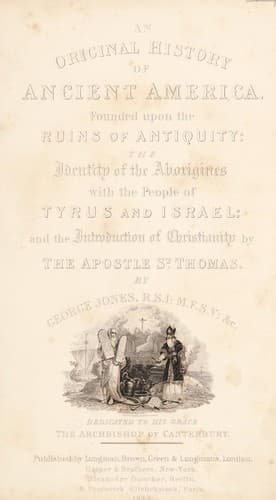
The History of Ancient America, Anterior to the Time of Columbus: Proving the Identity of the Aborigines with the Tyrians and Israelites; and the Introduction of Christianity into the Western Hemisphere By The Apostle St. ThomasJones, George
History
The History of Ancient America, Anterior to the Time of Columbus: Proving the Identity of the Aborigines with the Tyrians and Israelites; and the Introduction of Christianity into the Western Hemisphere By The Apostle St. Thomas
Jones, George
America -- Antiquities; America -- Discovery and exploration -- Phoenician; Indians -- Origin
From the time of Sisinnes the Nation continued to increase in wealth
and power. The former cause of her pride and glory--Navigation--was
revived with all the energy and perseverance for which their ancestors
in the time of Hiram had been so justly renowned. As in her days of
ancient fame, Tyrus had loaned and built fleets and navies for Israel
and Egypt, she now did the same for the Persian Monarch in his war
upon Greece. A double motive caused this,--not only the pride of being
able to furnish a navy, but her spirit of monopoly had again risen,
and begun to stalk abroad,--for Greece had already aroused the
jealousy of the Tyrians, and any means to crush or destroy the harbour
of the Peiræus, would advance their wishes. From the Persian they
could entertain no fears of commercial rivalry, for he had no river or
port upon the Mediterranean.
The honour of Tyrus, as a Nation, however, was shewn in refusing to
loan or man a navy, intended by a foreign king (who at first concealed
his intent) for carrying on a war against Carthage, and which denial
led to the abandonment of the proposed warfare. It will be remembered
that Carthage was originally founded by a Tyrian Princess and her
countrymen. The Patriotism of the Tyrians was as powerful as their
knowledge of Science was universal.
For thirty-five years Tyrus enjoyed the freedom of an independent
nation, when all Phœnicia was laid under contribution by the
Monarch of Persia:--He was content, however, with a mere nominal
tribute from the Tyrians in return for their aid against the
Greeks,--and perhaps from a distant belief that that assistance might
again be required. In furtherance of this design or policy, he did not
depose the reigning king, but recognised in him the exercise of full
powers (except the tribute) as a monarch of an independent nation.
480 B. C.] This nominal tribute was during the reign of Marten. The
king and nobles were willing to flatter the vanity of the Persian by
the nominal payment, for by his forbearance from any further action
against the Islanders, it enabled them to increase their power, and
retain their "places" both at home and abroad;--they, therefore, could
well afford to spare from their rich and overflowing treasury of
Pride, so small a portion of a superfluity.
ZECHARIAH wrote [ch. ix.] "And Tyrus did build herself a strong hold
[the Island-Citadel], and heaped up silver as the dust, and fine gold
as the mire of the street;"--but her Pride was as subtle, "as broad
and general as the casing air,"--it was in and around her,--it was
her nature,--to have been otherwise would have destroyed her identity
and nationality. It was, however, upon one occasion, exerted as a
noble spirit, and atoned for her errors past,--it proved that Freedom
was not dead within the walls of Tyrus;--and the now noble exertion of
the only Pride justifiable in any country,--that of National
Freedom,--led to the first and only Revolution in the annals of the
Tyrians in Asia. [475 B. C.]
Public-domain text, read in full here on John Shaqi.
Reviews
Reviews
No reviews yet
Be the first to share your thoughts on this work.
Elsewhere in the archive
Join the Discussion
Join the discussion
Sign in to leave a comment or review.
Sign InorCreate an account