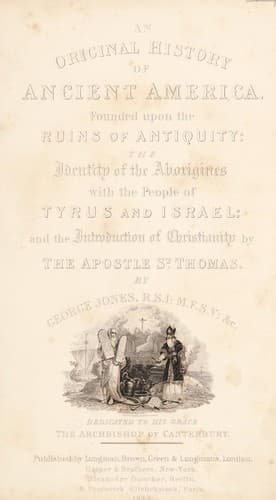
The History of Ancient America, Anterior to the Time of Columbus: Proving the Identity of the Aborigines with the Tyrians and Israelites; and the Introduction of Christianity into the Western Hemisphere By The Apostle St. ThomasJones, George
History
The History of Ancient America, Anterior to the Time of Columbus: Proving the Identity of the Aborigines with the Tyrians and Israelites; and the Introduction of Christianity into the Western Hemisphere By The Apostle St. Thomas
Jones, George
America -- Antiquities; America -- Discovery and exploration -- Phoenician; Indians -- Origin
Even in that time her builders had perfected her beauty. The Tyrian
Galleys were of peculiar strength and elegance, and their "means and
appliances" are especially dwelt upon by the Prophet. Senir furnished
the fir-wood for planks and decks,--Lebanon the cedar for masts,
yards, and timber,--Bashan the oak for the powerful oars,--the Rowers'
benches were of Ivory from Ethiopia and India,--the sails were of
embroidered fine linen from Egypt,--and the awning canopies of blue
and purple cloths, tinted with the renowned colour of her robes of
royalty. Mariners were constantly received from Sidon and Arvad,--the
important business of the caulkers was confined to the "wise men" of
Gebal,--but the builders and pilots were Tyrians only. To all the
Nations enumerated by EZEKIEL from whence riches were received in
exchange for merchandise, are now [335 B. C.] to be added the Islands
in, and the capitals bordering upon, the Mediterranean,--viz., Rhodes,
Sardinia, Sicily, Melita, Corsica, and the Baleares; Ægina, Crete,
Candia, Cyprus, Corcyra, and all the Grecian and Ionian Isles; the
newly-discovered lands of Britain and Hibernia, the former being named
by the Tyrians;--every Port from the mouth of the Menander to the
"Pillars" at Gibraltar; from the borders of Dalmatia to the opposite
shores of the Adriatic;--from the shores of Gaul and Iberia to the
harbours of Etruria,--and to all these commercial tributaries of
Tyrus, are to be added those giants of antiquity, Athens, Rome, and
Carthage! Truly, then, in the language of the inspired writer,
ZECHARIAH,--
"Tyrus did build herself a strong hold; and heaped up silver as the
dust, and fine gold as the mire of the street."
The same false Commercial policy was pursued by the Tyrians, as in
their more ancient days, when Pride and Envy were their injurious
counsellors. Their hands were raised against every nation seeking to
enrich itself through the means of Navigation;--those countries were
viewed by the Tyrians as the mere instruments of their own
advancement. Sidon and Carthage were alone excepted from the National
jealousy; and even this exception to the rule was founded upon
selfishness, arising from the memory of blood and kindred, and not
from any sentiment of liberal policy. The Metropolis being now on the
Island, they felt safe from the approach of an enemy by land,--while
their surrounding walls rendered them "quiet and secure" from every
assault by Naval warfare as then practised. In this imperial state of
confident security, founded upon Pride, locality, but above all by
commercial Monopoly, stood the Island-Kingdom of Tyrus, as her
death-knell was sounded from afar by the rising Monarch of Macedonia.
Throughout the surrounding Nations the Islanders had "sown the
wind,"--they were now, as a consequence, "to reap the whirlwind," and
no one to check, or blight, the pride-harvest of the hurricane!
Public-domain text, read in full here on John Shaqi.
Reviews
Reviews
No reviews yet
Be the first to share your thoughts on this work.
Elsewhere in the archive
Join the Discussion
Join the discussion
Sign in to leave a comment or review.
Sign InorCreate an account