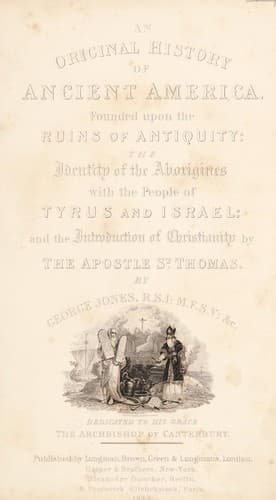
The History of Ancient America, Anterior to the Time of Columbus: Proving the Identity of the Aborigines with the Tyrians and Israelites; and the Introduction of Christianity into the Western Hemisphere By The Apostle St. ThomasJones, George
History
The History of Ancient America, Anterior to the Time of Columbus: Proving the Identity of the Aborigines with the Tyrians and Israelites; and the Introduction of Christianity into the Western Hemisphere By The Apostle St. Thomas
Jones, George
America -- Antiquities; America -- Discovery and exploration -- Phoenician; Indians -- Origin
Alexander commenced his triumphant march in the year 336 B. C., and
not having a sufficient cause for his foreign invasions (Persia and
Media excepted), may be justly looked upon, at this day, as the human
Juggernaut of Antiquity! The Prophet DANIEL, two centuries before the
period of which this event treats, stigmatized this vaunted hero, when
comparing him with the Kings of Media and Persia,--the latter to the
horns of the Ram, while the former is likened unto the brute Goat of
the mountains.
"And the rough goat is the King of Grecia." [Daniel viii. 21.]
It is not necessary to trace the progress of Alexander in Asia, only
so far as it may have had an influence upon the fate and fall of
Tyrus.
After the Passage of the Granicus, and in the next year, the great
victory at Issus, whereby the Persian kingdom was shaken, the lesser
nations begun to contemplate the increasing power of Alexander with
alarm, and to reflect upon the best means of averting impending ruin.
The only alternative from battle was to become tributary, or to obtain
the special favour of the Invader.
Sidon made application, through ambassadors, to Alexander for his
protection, and was thus saved from destruction by anticipating the
conflict through a tributary surrender:--and which voluntary act
satisfied the Macedonian, who stipulated, however, that he should
place a new King upon the throne. This was agreed to, and Byblos and
Aradnus joined in the humiliating surrender.
In compliment to his favourite,--Hephæstion,--the Conqueror allowed
him to appoint whom he pleased for King of Sidon. Hephæstion,
thereupon, selected a poor man of the Capital by the name of Strato,
and instantly raised him to the dignity of Sidonian Sovereign. The
mendicant was a remote branch of the Royal House, but had been
unjustly degraded by the reigning Monarch. When the new-raised King
had his first interview with Alexander, his grateful remark was--"I
pray that Apollo will enable you, Alexander, to bear prosperity with
the same fortitude, with which I have struggled with adversity!"
The Macedonian highly applauded the philosophical point of the remark,
and secured him in his new possession.
As no great gift can be without a referential motive, either to the
past, or for the future,--the donation by Hephæstion, where no past
service had deserved it (and there were nearer branches of the Royal
House than Strato), must have had, therefore, some deep meaning. It is
only long after historic events are passed and analyzed, that they can
be calmly or correctly judged; and in tracing Alexander's approach to
the celebrated "Daughter of Sidon," this donation of a throne,--and to
the party receiving it,--was in direct flattery to Tyrus; as in like
manner, at a subsequent period, Marcus Antonius presented provinces to
Egypt to secure the sun-clad and voluptuous Cleopatra!
Public-domain text, read in full here on John Shaqi.
Reviews
Reviews
No reviews yet
Be the first to share your thoughts on this work.
Elsewhere in the archive
Join the Discussion
Join the discussion
Sign in to leave a comment or review.
Sign InorCreate an account