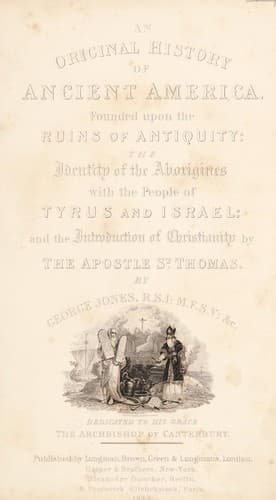
The History of Ancient America, Anterior to the Time of Columbus: Proving the Identity of the Aborigines with the Tyrians and Israelites; and the Introduction of Christianity into the Western Hemisphere By The Apostle St. ThomasJones, George
History
The History of Ancient America, Anterior to the Time of Columbus: Proving the Identity of the Aborigines with the Tyrians and Israelites; and the Introduction of Christianity into the Western Hemisphere By The Apostle St. Thomas
Jones, George
America -- Antiquities; America -- Discovery and exploration -- Phoenician; Indians -- Origin
Upon the occupation of the mainland suburbs (the Tyrians and strangers
having fled to the Island), all the then known engines of warfare
(both of defence and offence) were constructed and arranged upon the
shore,--the army encamped on elevated ground, so as to be seen from
the Capital,--the Cavalry and Phalanx daily practised their complex
evolutions,--all this display was for the purpose of intimidating the
besieged,--but it failed in its intended object. Orders were then
given to commence an attack, not so much upon the walls, as upon the
People, by throwing into the City darts and missiles: but, high Towers
for the bowmen,--Balistæ for discharging heavy stones,--Catapultæ for
casting forth the deadly javelin,--were erected with no effect; for
the clouds of lightning-arrows, and the heavy thunderbolts of war
burst forth in vain; and the distant walls remained unscathed, and the
Tyrians unharmed. Alexander must now have found the error in
dismissing his Navy after the Passage of the Granicus: had he retained
it, he would have been enabled, upon a victory over the Tyrian fleet,
to have surrounded the walls, and so prevent supplies from entering
the Metropolis; but which were now daily received by the besieged,
without the power of prevention on the part of the Macedonian. In this
dilemma Alexander proposed to Azelmic and his Council, terms of
capitulation similar to those accepted by the Sidonians; but with the
original proposition of offering a sacrifice in the temple of
Hercules-Apollo. The "sacrifice" would have been the entire People!
The Tyrians, however, feeling safe within their walls, received the
proffered negotiation with scorn and contempt; and in regard to the
last proposition, they still resolved not to admit Alexander, or even
his peace-offering.
The Macedonian now felt for the first time, that his hitherto
untarnished glory might be dimmed,--his future pathway might be
clouded,--for to abandon the Siege would instantly destroy his
reputation for invincibility. Even his Generals were at a loss for
means to conceal their mortification, or of resources of invention,
whereby the reduction of the Capital could be accomplished. They,
however, suggested to Alexander, that his already brilliant fame would
not be clouded, by passing on to other victories obtainable upon the
land; for it was not originally intended in his present advance, to
attack a strongly-fortified Island, surrounded by the broad waters of
the Mediterranean, and with high walls based upon the very waves of
that Sea; and then the distance of the Isle from the mainland, placed
the besieged out of the reach of either fear or danger; and especially
in the absence of his fleet. These and similar arguments were of no
avail; for every suggestion of a present, or of a future difficulty,
only increased Alexander's resolution to conquer.
Public-domain text, read in full here on John Shaqi.
Reviews
Reviews
No reviews yet
Be the first to share your thoughts on this work.
Elsewhere in the archive
Join the Discussion
Join the discussion
Sign in to leave a comment or review.
Sign InorCreate an account