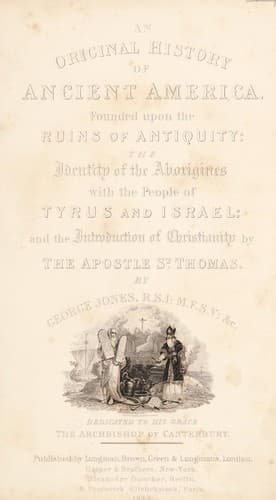
The History of Ancient America, Anterior to the Time of Columbus: Proving the Identity of the Aborigines with the Tyrians and Israelites; and the Introduction of Christianity into the Western Hemisphere By The Apostle St. ThomasJones, George
History
The History of Ancient America, Anterior to the Time of Columbus: Proving the Identity of the Aborigines with the Tyrians and Israelites; and the Introduction of Christianity into the Western Hemisphere By The Apostle St. Thomas
Jones, George
America -- Antiquities; America -- Discovery and exploration -- Phoenician; Indians -- Origin
The Prince in his early youth had Nature for his guide,--and that
great Monitress then led him to accomplish his first victory: for the
untameable horse, Bucephalus,--the Mazeppa-charger of Macedonia,--was
not subdued from merely having the Lord of Wit or Wisdom by his side,
but because he exercised the high gift for which he had been so justly
named.[12] He, therefore, _did_ turn the head of the proud animal
"towards the East;" and in paying this supposed tribute to Apollo, he
compelled the fiery steed _to gaze upon the dazzling Sun_!--and while
thus partially blinded by the brilliant rays, the dauntless rider
mounted him, and the noble animal, feeling for the first time the
weight of man,--the lash and the deep-wounding spur,--forth he bounded
like an earthly Pegasus,--clouds of sand and dust rising from beneath
his earth-spurning, and indignant hoofs, concealed from the royal
Father's sight the form of his princely Son, and the now maddened
steed:--yet on he flew, like a Sirocco blast before the hurricane--his
eyes still towards, and in, the dazzling Sunlight:--but, ere Apollo
had reached the zenith, the horse and rider returned to the royal
presence, the latter triumphant, and the former for the first time
subdued, and gazing upon his shadow! Thus by Nature, and her laws, did
he tame the fiery spirit!
[12] Viz., the word Alexander, in the original formation,
signified _Lord of Wit, i. e. Wisdom_, in ancient days.
It was a similar thought that led him to conceive the means for
subduing the apparently unconquerable spirit of the proud Tyrian, safe
within his untouched Island-Citadel,--as that which led him upon the
plain of Macedon, to master the white steed Bucephalus--who now stood
prancing upon the moonlit shore of ancient Tyrus, with his Princely
Master upon his gracefully-curved back as upon a throne of
ivory:--from this regal seat,--while the noble steed gazed upon the
phosphoric sparkles of the radiant sea, as the waves cast them at his
feet,--the pupil of Aristotle contemplated the apparently hopeless
Siege of the commercial emporium of the World! That contemplation
placed before him the fact, that Nature was to be subdued before the
successful appliances of Art could be brought to bear upon and support
his resolution. It forced upon him the conclusion that he had not
only to war against Island walls, and Patriot hearts within,--but
against another kingdom over which the trident monarch--Neptune--reigned,
guarding with safety and with honour the renowned "Queen of the
Sea,"--that he must drive back that victorious ally before he could
even hope to capture her coronet of freedom! He remembered, too, that
both the Babylonian and the Persian had retired, leaving their
victories imperfect by not subduing the Island;--this was an
additional reason why he resolved to conquer, that his military glory
should, in the estimation of posterity, be beyond any predecessor.
Public-domain text, read in full here on John Shaqi.
Reviews
Reviews
No reviews yet
Be the first to share your thoughts on this work.
Elsewhere in the archive
Join the Discussion
Join the discussion
Sign in to leave a comment or review.
Sign InorCreate an account