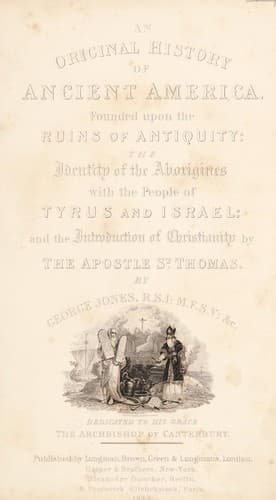
The History of Ancient America, Anterior to the Time of Columbus: Proving the Identity of the Aborigines with the Tyrians and Israelites; and the Introduction of Christianity into the Western Hemisphere By The Apostle St. ThomasJones, George
History
The History of Ancient America, Anterior to the Time of Columbus: Proving the Identity of the Aborigines with the Tyrians and Israelites; and the Introduction of Christianity into the Western Hemisphere By The Apostle St. Thomas
Jones, George
America -- Antiquities; America -- Discovery and exploration -- Phoenician; Indians -- Origin
July, 332 B. C.] In the sixth month from the commencement of the
siege, the invaders had advanced to the foot of the walls, and in
approaching they widened the Causeway, in order to enable them to have
greater space for carrying on the operations of Storming the Capital.
Upon the successful termination of constructing the Mole, the engines
of ancient warfare were placed in their several localities for active
service. In front, and near to the walls (which were of soft stone and
stuccoed), were stationed several battering-rams of enormous magnitude
and power, and swung from high triangles and towers, in order to
batter the upper, and consequently the weakest part of the mural
defence. Behind these engines, at a short distance, were placed the
powerful Balistæ and Catapultæ for throwing stones and timber, darts
and javelins into the city. In the third position from the walls, were
stationed several high wooden-towers, from four to six stories in
altitude, and manned with archers; each story had its drawbridge, both
for defence, and to let down upon, or into any breach that might be
made, and from which bridge the archers and spearmen could pass on to
the walls, upon the huge machines being wheeled forward by the
Soldiery in the rear of the towers. The now Grecian Galleys (captured
from the Tyrians) were brought and moored along the sides of the Mole,
having their lines trebled near, and especially at the Island-base of
the causeway. This precaution was to prevent escape in case of any
sortie; as, also, to give protection to the new Military work against
the continual injury from the waves. This action and locality of the
captured vessels _left the walls towards the Sea unwatched_, and it
was considered by the invaders as useless to keep their small fleet
dispersed, when no escape could be made by the Tyrians in that
quarter, from the want of vessels; therefore, from the oblong form of
the Island-Capital (its sides being parallel with the Sea and the
mainland), _it would prevent those engaged at the Causeway, from
seeing any movement or enterprise, that might be undertaken at the
Seaward gates of the Metropolis_. This fact is of great importance,
and for the full appreciation of the result, the reader should not let
it escape from memory. During the successful advance, the Tyrians had
been incessant in their defence of Nature's Moat; but, now that it was
passed by the enemy, their only duty was to prevent a breach being
made in the wall: this defence was comparatively easy, for the attack
could only be made upon one point, and the only approach to that
assault was over the Causeway.
Public-domain text, read in full here on John Shaqi.
Reviews
Reviews
No reviews yet
Be the first to share your thoughts on this work.
Elsewhere in the archive
Join the Discussion
Join the discussion
Sign in to leave a comment or review.
Sign InorCreate an account