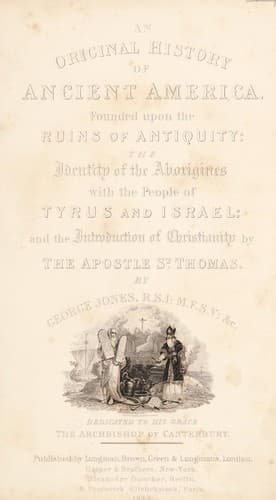
The History of Ancient America, Anterior to the Time of Columbus: Proving the Identity of the Aborigines with the Tyrians and Israelites; and the Introduction of Christianity into the Western Hemisphere By The Apostle St. ThomasJones, George
History
The History of Ancient America, Anterior to the Time of Columbus: Proving the Identity of the Aborigines with the Tyrians and Israelites; and the Introduction of Christianity into the Western Hemisphere By The Apostle St. Thomas
Jones, George
America -- Antiquities; America -- Discovery and exploration -- Phoenician; Indians -- Origin
When Alexander had personally inspected the fulfilment of his
instructions, he commanded a simultaneous assault to be made upon the
wall and city, from every warlike engine on the Causeway. It was
useless: the brave defence exceeded in its results any injury received
from the spirit of the attack; for where the battering-rams would
otherwise have had effect, bales of cloths, linen and wool were hung,
so that no impression could be made; at the same time hundreds of the
invaders were crushed or slain by the high-mounted besieged, who
continued to hurl down upon those beneath, and upon their works,
ponderous stones, showers of darts and javelins, together with ignited
combustibles and fascines. In this manner were several attempts upon
the City completely foiled by the Tyrians. The Macedonians were,
therefore, compelled to retire towards the shore, for the purpose of
repairing their shattered and burnt engines and towers;--and who, amid
the irreverend shouts of triumph from the Islanders, daily buried
their dead within the adjacent camp: but these untimely rejoicings,
and the death of the Envoys, only the more securely sealed the
judgment upon Tyrus!
It has already been stated that the vessels composing the captured
fleet had been moored on either side of the Causeway, and consequently
they were placed between the Island and the shore. Upon this
disposition of the Macedonian Navy being made known at _Sidon, several
of her most determined Citizens manned a few of their own
merchant-galleys, hoisted sails, and lowered oars for Tyrus_, which
was distant but twenty-three miles. They arrived and hovered on the
sea-side of the Island, so as to be unperceived by the invaders; and
even if they were seen at, or after the storming of the city, they
were _Sidonians_, and would be treated by the besiegers in a friendly
manner, for they were already tributary to the Macedonian. Their deep
_intent_, however, could not be known, and their _presence_ merely,
would, therefore, pass unquestioned. Although, by their intended act,
a portion of the Sidonians broke their treaty of surrender with
Alexander, and were in fact as guilty as if detected in the act
itself, and consequently within the sentence of death; still they were
determined to prove the truth of a prior faith to the Tyrians, and
were thus prepared to rescue any "remnant" of their descendants,
should the City be stormed and taken.
It was no hollow friendship that amid the whirlwind would come forth,
and from the Conqueror's field of blood--the Aceldama of his shame and
cruelty--would boldly "glean" the Tyrian "olive-tree," or the
remaining fruit from Slaughter's "vintage." This was an act worthy of
renown from the Sculptor's magic, yet enduring Art, worthy to grace
the "Chief Altar" of a land, wherever the "gleanings" of the
bloody-harvest should be housed in safety!
Public-domain text, read in full here on John Shaqi.
Reviews
Reviews
No reviews yet
Be the first to share your thoughts on this work.
Elsewhere in the archive
Join the Discussion
Join the discussion
Sign in to leave a comment or review.
Sign InorCreate an account