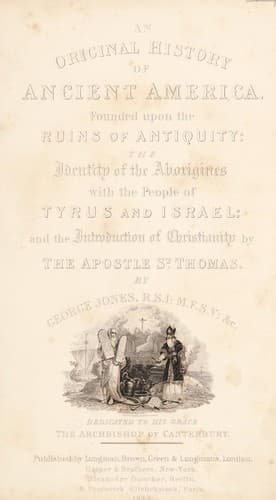
The History of Ancient America, Anterior to the Time of Columbus: Proving the Identity of the Aborigines with the Tyrians and Israelites; and the Introduction of Christianity into the Western Hemisphere By The Apostle St. ThomasJones, George
History
The History of Ancient America, Anterior to the Time of Columbus: Proving the Identity of the Aborigines with the Tyrians and Israelites; and the Introduction of Christianity into the Western Hemisphere By The Apostle St. Thomas
Jones, George
America -- Antiquities; America -- Discovery and exploration -- Phoenician; Indians -- Origin
August, 332 B. C.] In the seventh month of the Siege, the invaders had
repaired and increased the number of their warlike engines and
machines, and especially those for battering down the walls. They were
now replaced, but stationed out of danger of the ignited fascines, to
await the final orders of the King of Macedon, who had retired to the
neighbouring Mountain for recreation, until the preparations should be
completed for a renewal of the assault. In the mean time the soldiers
of Alexander, accustomed to speedy victories, began to murmur at their
long and arduous duties, and at the number of their useless dead,
which had made their camp nearly a pestilential charnel-house. They
desired that the Siege should be instantly raised, that they might
march on to certain victories, and so efface their present infamy of
defeat. In these sentiments they were joined by many of the subaltern
officers; and the growing spirit of open mutiny was roaming through
every division of the army.
During this cessation of active hostilities, the Tyrians were making
preparation for the great Annual Festival in honour of their tutelary
God,--Apollo,--which had been postponed from the summer solstice,
owing to the position of the Siege. In this Religious ceremony no one
could be excused, or excluded; even the sentinels from the ramparts
must leave the steps of war, for the paths of peace: all must join in
devotion and thanksgiving to the protecting Sun, which, as Apollo, was
supposed at Midsummer to reach his altitude of beatific power. Any
Tyrian, therefore, who did not worship the rising of the great Deity
of Phœnicia upon that day, was believed to be banished from his
genial influence, during the next annual circling of their Zodiac.
It was in the fulness of the Moon's last quarter, in the month of
August, that Alexander, having left his Pavilion on the Mountain, and
wandering alone through the deep vistas, suddenly cast his war-mantle
at the foot of a giant cedar of Lebanon; and reclining thereon,
perused a few pages of the Iliad, his fond and fatal companion,--but
from anxiety and fatigue was soon in slumber. The sleeper was as
solitary as the tree beneath which he slept--for they were both alone
in station as they were in character. The Moon had risen in unclouded
splendour, and cast her beams, as in playfulness, upon the child of
fortune; like celestial Cynthia, when, upon the retiring of her
attendants--the Stars of Night--she cast her virgin smiles upon the
earthly beauty, and youthful figure of Endymion; for the now sleeping
hero had seen but twenty-four summers, and those without a cloud to
dim their brilliancy. He now dreamed of Tyrus and her downfall,--a
smile played around his lips, triumphant as Apollo's:--he suddenly
sprung to his feet and grasped his sword;--the action was but the
active portion of his visioned victory, for--
Public-domain text, read in full here on John Shaqi.
Reviews
Reviews
No reviews yet
Be the first to share your thoughts on this work.
Elsewhere in the archive
Join the Discussion
Join the discussion
Sign in to leave a comment or review.
Sign InorCreate an account