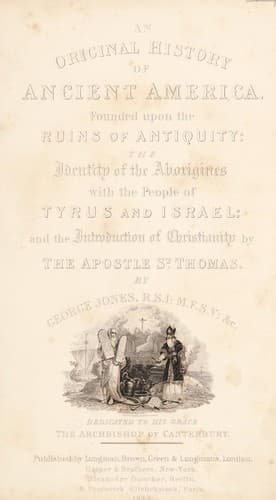
The History of Ancient America, Anterior to the Time of Columbus: Proving the Identity of the Aborigines with the Tyrians and Israelites; and the Introduction of Christianity into the Western Hemisphere By The Apostle St. ThomasJones, George
History
The History of Ancient America, Anterior to the Time of Columbus: Proving the Identity of the Aborigines with the Tyrians and Israelites; and the Introduction of Christianity into the Western Hemisphere By The Apostle St. Thomas
Jones, George
America -- Antiquities; America -- Discovery and exploration -- Phoenician; Indians -- Origin
The _New Testament_ was originally written in the Greek language,--for
that was the language of the learned at the period of the
Apostles,--and consequently the Gospel was quickly promulgated--both
by writing and preaching--to the nations surrounding Jerusalem:--thus
the invasion of Alexander,--by establishing in Syria, Palestine, and
Egypt, one language, (_i. e._ the Greek) became an instrument,
(although from a pagan,) for the promulgation of the true
Faith,--thence fulfilling that "from evil cometh good."
The latest date of Ezra is 456 B. C., and sceptics boldly assert "That
no Prophecy _previously_ announced [as to date] in the Bible, can be
proved from _history_ to have been fulfilled _after_ that date!"
The first refutation (apart from THE REDEEMER'S prophesied birth) is
from the Prophet DANIEL. From his vision he foretold that the fall of
the Medes and Persians should be caused by a Grecian monarch (_i. e._
Alexander of Macedon), the former were portrayed as the horns of a
Ram, and the latter as a brutal Goat. "And the Ram which thou sawest
having two horns are the kings of Media and Persia,--and the rough
goat is the king of Grecia." The _cause_ for Alexander's invasion of
his enemy's territory is then given: "Behold there shall stand up yet
three kings in Persia, and the fourth [Darius] shall be far richer
than they all, and by his strength, through his riches, _he shall stir
up all against the realm of Greece_."
The Prophecy then actually foretells what shall happen upon the death
of Alexander, whereby his identity as the "king of Grecia" is
absolute,--viz.,
"His (king of Grecia) kingdom shall be broken, and _shall be divided_
towards the four winds of Heaven, and _not to his posterity_, nor
according to his dominion (Macedonia) which he ruled; for his kingdom
shall be plucked up, even for others besides those [_i. e._ his
posterity]. Now that (Alexander's dominion) being broken, whereas
_four_ stood up for it,--_four kingdoms shall stand up out of the
nation_--and in the latter time of their kingdom, when the
transgressions are come to the full, a king of fierce countenance, and
understanding dark sentences shall stand up."
Public-domain text, read in full here on John Shaqi.
Reviews
Reviews
No reviews yet
Be the first to share your thoughts on this work.
Elsewhere in the archive
Join the Discussion
Join the discussion
Sign in to leave a comment or review.
Sign InorCreate an account