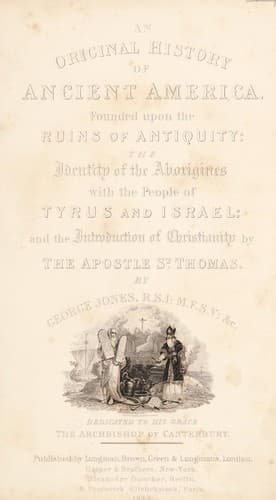
The History of Ancient America, Anterior to the Time of Columbus: Proving the Identity of the Aborigines with the Tyrians and Israelites; and the Introduction of Christianity into the Western Hemisphere By The Apostle St. ThomasJones, George
History
The History of Ancient America, Anterior to the Time of Columbus: Proving the Identity of the Aborigines with the Tyrians and Israelites; and the Introduction of Christianity into the Western Hemisphere By The Apostle St. Thomas
Jones, George
America -- Antiquities; America -- Discovery and exploration -- Phoenician; Indians -- Origin
The humble gravestone of the village churchyard is received as legal
evidence of death,--it speaks a name, a date, and burial,--the
Acropolis, as the tomb of Athens, can do no more, save that it is the
record of a nation's downfall, and not a peasant's.
Sculpture can speak even of the Religious mind of the deceased,--bring
it to memory, and instruct us as to the means whereby the departed
attained his hope of Salvation,--it presents the transparent medium
through which he gazed upon futurity, and believed in his approach to
God: for the Cross or Crescent upon a tombstone, needs no other
language to inform the passer-by, that the departed was a follower of
Christ or Mahomet! If then the mind of a solitary corpse can, as it
were again be vivified, by merely contemplating the sculptured emblem
of the dead, and that from a single gravestone, may not entire nations
be historically resuscitated, when the human eye and mind are brought
to gaze upon, and investigate whole Cities of Ruins, with their
sculptured Temples, Tombs, and Palaces? Yes! though they should be
found amid the darkened forests of the Western Continent, where the
panther and beasts of prey were thought alone to dwell. Yes! Palenque,
Copan, Chiapas, and their muraled sisters, have historic voices for
posterity from their "cities of the dead," the Pompeii and the
Herculaneii of the Western Hemisphere,--yet more aged and venerable
than even those victims of Vesuvius!
Architecture and Sculpture then claim the right to be received as
undeniable evidences of historical record; and, as such, those two
branches of the Fine Arts will be admitted by the reader in support,
and in illustration of the Epoch now under investigation. Ictinus,
Phidias, and Praxiteles,--Bramante, Jones, and Wren,--Canova,
Chantrey, and Greenough, may justly be regarded as historians; for
from the volumes of their art, events and æras can be traced and
established.
SECTION II.
PAINTING.
Painting,--the most beautiful in the triumvirate of the Arts, proudly
follows Sculpture in her classic path,--the precedence only yielded as
to one of elder birth, who attired in her snow-white raiment marches
forward with majestic step, casting her shadow to the confines of
History; while her graceful follower, clad in the rainbow-tinted
garments, and having no shadow of herself, receives her coloured
brilliancy from the glowing Sun of Genius, and thence in gratitude
reflects back her pictorial light to illuminate the mind! This
delightful art may be defined to be a species of poetic and historic
writing, and subservient to the same ends--the expression of ideas and
events--of Nature and her children. It bears resemblance to the
diamond in the dark recesses of the earth, which by its own innate
quality emits sparkling rays of light, thereby not only discovering
its own splendour, but giving a lustre to obscurity.
Reviews
Reviews
No reviews yet
Be the first to share your thoughts on this work.
Join the Discussion
Join the discussion
Sign in to leave a comment or review.
Sign InorCreate an account