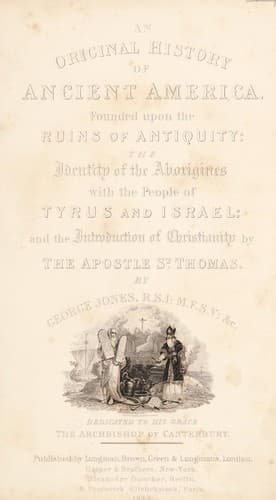
The History of Ancient America, Anterior to the Time of Columbus: Proving the Identity of the Aborigines with the Tyrians and Israelites; and the Introduction of Christianity into the Western Hemisphere By The Apostle St. ThomasJones, George
History
The History of Ancient America, Anterior to the Time of Columbus: Proving the Identity of the Aborigines with the Tyrians and Israelites; and the Introduction of Christianity into the Western Hemisphere By The Apostle St. Thomas
Jones, George
America -- Antiquities; America -- Discovery and exploration -- Phoenician; Indians -- Origin
A brief review of the discovery of the Ruins and their locality will
now be required. From a record by Huarros of Guatimala, and that on
the authority of Fuentes, the ruins of Copan were known in 1700.
Palenque was visited by Del Rio; and by Dupaix about 1805. In the
beginning of the nineteenth century, the scientific Humboldt visited
Mexico; he obtained drawings of the ruins of Mitla, in the Province of
Oaxaca, and others of a similar character, but especially the
terraced-pyramid of Cholula, which he visited. The investigations were
published by the same scholastic traveller. At a later period, Uxmal
(Yucatan) was explored under a commission of the Spanish Government by
Waldeck; his work (folio) is most beautifully illustrated. In
compliment to the nobleman who published the great work on the Ancient
Mexican Paintings, he called one of the ruins, _The Pyramid of_
_Kingsborough_--an anachronism, perhaps, allowable when the motive is
considered. Copan was visited by Galindo in 1836; but he lacked the
perseverance necessary for a perfect exploration. This latter
desideratum was fully evinced by Stephens and Catherwood who, in
1839-40, visited and explored all of the above (excepting those seen
by Baron Humboldt), and several cities before unknown in general
history. As a geographical position, the localities of these dead
cities are between the capital of Mexico and the Isthmus of Darien,
but chiefly in Guatimala; on the borders of Yucatan, and on that
Peninsula; they therefore occupy the narrow part of the Continent
between the two great oceans. A reference to the map of Central
America, will aid the following remarks:
The river Montagua empties itself into the Bay of Honduras, at or
near, Omoa; approaching the source of this river, it branches off to
the South, which branch is called Copan River; above the rapids of
this branch-river, is situated on the banks the now celebrated ruined
City of Copan, over _two miles_ in extant, parallel with the stream.
Palenque is nearer Mexico. The ruins of Uxmal are in Yucatan. From the
Architectural characteristics of the edifices, we find no difficulty
in arranging the order of their being built, which, with all due
respect for the opinion of others, we submit to be as follows:
viz.--first, the city of Copan, then Cholula, followed by Quirigua,
Tecpan-Guatimala, Quiché, Gueguetinango, Ocosingo, Mitla, Palenque,
and lastly, Uxmal: and about the same period of building, the cities
of Chi-Chen, Zayi, Kabah, Espita, and Ticol,--these last being in the
Peninsula of Yucatan. Compared with these relics of past centuries, we
consider the City of Mexico to be of comparatively modern date, _at
the time of the Spanish conquest_ (A. D. 1520).
Reviews
Reviews
No reviews yet
Be the first to share your thoughts on this work.
Join the Discussion
Join the discussion
Sign in to leave a comment or review.
Sign InorCreate an account