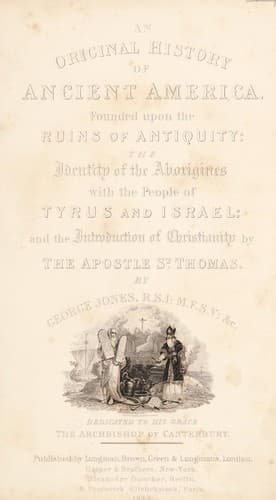
The History of Ancient America, Anterior to the Time of Columbus: Proving the Identity of the Aborigines with the Tyrians and Israelites; and the Introduction of Christianity into the Western Hemisphere By The Apostle St. ThomasJones, George
History
The History of Ancient America, Anterior to the Time of Columbus: Proving the Identity of the Aborigines with the Tyrians and Israelites; and the Introduction of Christianity into the Western Hemisphere By The Apostle St. Thomas
Jones, George
America -- Antiquities; America -- Discovery and exploration -- Phoenician; Indians -- Origin
He has given indeed by his pen, and the artist by his pencil, a
reflection of the Ruins, but it is from a mirror of polished ebony,
simply a _fac-simile_ resemblance,--light and shade only,--a specimen
of Daguerreotype! No one can mistake the rapid manner in which the
true copy is impressed upon the mind, and that by the most easy and
agreeable means--viz., the fascination of his style; but the
_colouring of life_ is not there,--_the Soul of History is wanting_!
The Promethean spark by which the flame of historic truth should
illuminate his work, and be viewed as a gleaming beacon from afar, to
direct wanderers through the dark night of wonders, has found no spot
to rest upon and to vivify! But this he has done,--he has brought the
timbers of the historic bark to view:--research must build, and
science place the rudder; the pilot, constant as the northern star;
enthusiasm must drive her before the wind, every sail set, fore and
aft, aloft, abroad and full, and it will be strange indeed if that
spark will not be found upon Truth's phosphoric sea!
If these Ruins can be identified with a nation of the ancient
world,--_ancient_ world?--the first word is superfluous now, for these
discoveries have destroyed the opposite phrase,--_new_ world;--that
expression will belong hereafter to England and parts of Europe, not
America; for the former date from the first Cæsar,--the latter, if we
err not, from an older and a greater conqueror! If, we say, these
Ruins can be identified with a country of Asia, and of "the olden
time," we shall have no regret for having turned shipwright to aid the
discovery of that nation; and if our classic galley should founder ere
we reach "the point proposed," we shall at least struggle in the
buoyant waves of hope and pleasure, our light heart floating above the
waters of disappointment; and with joyous pride will we hail those who
in passing by have found and steered a truer track!
First will be given a description of such parts of the great Ruins as
may be necessary in the author's own words, with such commentaries as
may be required by the narration: then will follow Mr. Stephens's
reflections upon all the Ruins; his arguments will be met, his errors
detected, his contradictions investigated, and thereupon we shall
endeavour (at least) to completely refute his deductions and
conclusions.
SECTION II.
THE RUINS OF COPAN.
"They are in the district of country now known as the state of
Honduras, one of the most fertile valleys of Central America." Their
precise locality was stated in the last section, with the exception
that their distance from the sea is about "three hundred miles."
"The Copan river is not navigable, even for canoes, except for a short
distance in the rainy season."
This is a description of the River now (1843), and not as it may have
appeared at the time of erecting the edifices.
"Falls intercept its course before it empties into the Montagua."
Reviews
Reviews
No reviews yet
Be the first to share your thoughts on this work.
Join the Discussion
Join the discussion
Sign in to leave a comment or review.
Sign InorCreate an account