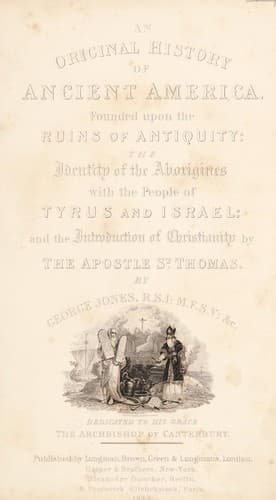
The History of Ancient America, Anterior to the Time of Columbus: Proving the Identity of the Aborigines with the Tyrians and Israelites; and the Introduction of Christianity into the Western Hemisphere By The Apostle St. ThomasJones, George
History
The History of Ancient America, Anterior to the Time of Columbus: Proving the Identity of the Aborigines with the Tyrians and Israelites; and the Introduction of Christianity into the Western Hemisphere By The Apostle St. Thomas
Jones, George
America -- Antiquities; America -- Discovery and exploration -- Phoenician; Indians -- Origin
"Within this enclosure are two rectangular courtyards, having ranges
of steps ascending to terraces. The area of each is about forty feet
from the river. On one side at the foot of the pyramidal wall is
another monument or idol, [_i. e._ sculptured obelisk]. It is about
the same height as the others (in all fourteen), but differs in shape,
being larger at top than below. Its appearance and character are
tasteful and pleasing."
We desire to call the particular attention of the reader to the
following piece of sculpture, as it will hold a conspicuous position
as we advance in this volume.
"Near this [idol last mentioned] is a _remarkable altar_, which
perhaps presents as curious a subject for speculation as any monument
at Copan. The altars, like the idols, are all of a single block of
stone. In general, they are not so richly ornamented, and are more
faded and worn, or covered with moss. All differed in fashion, and
doubtless had some distinct and peculiar reference to the idols before
which they stood."
Each of the idols, therefore, had an altar before it, and each of the
altars had its relative idol, _except_ the one about to be described.
"This altar stands on four globes (?) cut out of the same stone: the
sculpture is in _bas-relief_, and it is the _only specimen of that
kind of sculpture found at Copan_, all the rest being in bold
_alto-relievo_."
By a reference to the map for its locality, we find that it is
situated nearly in the very centre of the vast Temple. This, together
with its being alone, unassociated with an Idol--the sculpture being
entirely different, and "the only specimen" found there, all the
others being in _alto_, but this in _basso_--(a proof of its greater
antiquity)--the very stone seems to find a voice to proclaim that it
was the Chief Altar of Copan. It may be "a curious subject," but
certainly does not require much "speculation" to form a conclusion.
The description of the detail of the sculpture seems to furnish
another reason for believing it to be the principal Altar.
"It is six feet square, and four feet high; and the top is divided
into thirty-six tablets [or squares] of _hieroglyphics_, which beyond
doubt _record some_ EVENT _in the history_ of the mysterious people
who once inhabited the city."
This we distinctly believe; and that the _sculpture_ about to be
described, TRANSLATES THE HIEROGLYPHICS, and those being translated,
the "event in the history" is then arrived at. Whether we have
accomplished this or not, the reader will judge as he proceeds,--for
we have looked upon this Chief Altar as the "Rosetta-stone" of the
ruins--the Key-stone in the arch of mystery.
Reviews
Reviews
No reviews yet
Be the first to share your thoughts on this work.
Join the Discussion
Join the discussion
Sign in to leave a comment or review.
Sign InorCreate an account