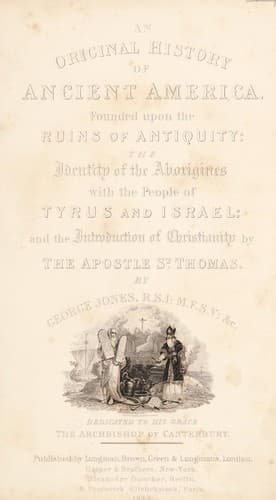
The History of Ancient America, Anterior to the Time of Columbus: Proving the Identity of the Aborigines with the Tyrians and Israelites; and the Introduction of Christianity into the Western Hemisphere By The Apostle St. ThomasJones, George
History
The History of Ancient America, Anterior to the Time of Columbus: Proving the Identity of the Aborigines with the Tyrians and Israelites; and the Introduction of Christianity into the Western Hemisphere By The Apostle St. Thomas
Jones, George
America -- Antiquities; America -- Discovery and exploration -- Phoenician; Indians -- Origin
We have already called this edifice the _Temple_, believing it not to
have been originally a palace. This distinction is nearly defined from
the fact that _hieroglyphics_ are found upon the edifice: for
hieroglyphics (_i. e._, sacred and symbolical writing) constitute the
Religious language of nearly all the ancient nations,--but of Egypt
especially. The language of Religion and the Hieratic (that of the
priests) were placed upon the _sacred_ edifices, and being so placed,
proved them to be Temples. Those languages were, also, painted upon
mummy-cloths and coffins, or sculptured upon the outward granite
Sarcophagii,--the Egyptians holding the rights of Sepulture in the
most sacred estimation; for those rights were only granted upon a
public investigation of the character of the deceased, and a general
verdict in his favour. This _post-mortem_ examination of character
even the king was not exempt from, and the poorest subject of Egypt
could bring his accusation against the deceased monarch; with the
privilege of sustaining his charges by facts and argument,--for by the
laws of Egypt every Egyptian was considered equal and noble with his
countrymen,--Character and Talent being the only distinctions to
entitle the deceased to sepulture, and the hieroglyphical
inscriptions to perpetuate a name. The King of Egypt might (and it was
a custom) build his own monument and Sarcophagus, inscribe them with
his victories and virtues; but his body (after death) would not be
placed within, unless at the public ordeal upon his life and character
the _People_ should grant permission.
If such a custom obtained at the present day, how many lying
tomb-stones and monumental effigies would escape the charge of
falsehood; and how many unrecorded possessors of talent and character,
would breathe in marble for the imitation of their posterity!
The Enchorial language (_i. e._ the common or spoken) was not placed
(alone) on sacred edifices: therefore its absence on a building almost
demonstrates that building to have been erected and adorned for sacred
purposes. Upon this consideration we shall view the great edifice of
Palenque,--as the Temple, and not the Palace. And, it might naturally
be asked if this is a Palace, where is the Temple?--for in all ancient
nations the Temple of worship was always the grandest edifice of a
metropolis: the same custom is still continued in more modern
times,--Rome has its St. Peter's, and London its St. Paul's.
The hieroglyphics on the Altar and Idols of Copan (_vide_ last
Section) in a similar manner demonstrate those sculptures to be of a
Religious character, but that fact does not preclude the association
of Historical events,--they were so introduced and incorporated by
the Egyptians and the ancients, in order to _deify_ those events;--and
by thus rendering a sacristy of character to the hero, or the glory,
to give them both (in their belief) an earthly, or rather a celestial
immortality!
Reviews
Reviews
No reviews yet
Be the first to share your thoughts on this work.
Join the Discussion
Join the discussion
Sign in to leave a comment or review.
Sign InorCreate an account