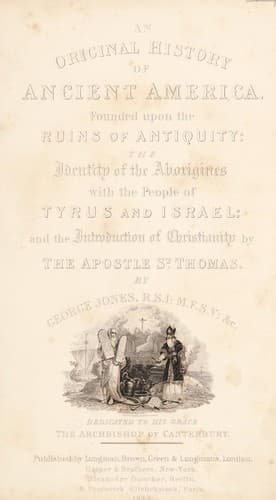
The History of Ancient America, Anterior to the Time of Columbus: Proving the Identity of the Aborigines with the Tyrians and Israelites; and the Introduction of Christianity into the Western Hemisphere By The Apostle St. ThomasJones, George
History
The History of Ancient America, Anterior to the Time of Columbus: Proving the Identity of the Aborigines with the Tyrians and Israelites; and the Introduction of Christianity into the Western Hemisphere By The Apostle St. Thomas
Jones, George
America -- Antiquities; America -- Discovery and exploration -- Phoenician; Indians -- Origin
This last sentence cannot be entertained,--for _mosaic_ is an
arrangement of COLOURED stones, to represent a _painted floor_, wall,
or ceiling,--their shape is not material, but they must be possessed
of different colours. Now this does not appear upon the walls of Uxmal
[_i. e._ of the edifice now in review], and the absence of _coloured_
stones gives the negative to their being even "a species of mosaic."
Nor were the stones _first_ sculptured, "and then set in their places
in the wall;" that is entirely a modern custom; but by applying the
history of ancient sculpture to the preceding description, the means
whereby the accuracy of facial sculpture of the wall was obtained, is
at once defined and established. The Greeks placed the stones of their
friezes and pediments upon their Temples in their _rough
state_,--_they were sculptured afterwards_, and consequently the
greatest accuracy in the connecting lines from one stone to another
was obtained, and could be by that manner only. The fluting of a
column (of one or more blocks of marble) was always sculptured _after_
it had been erected in its rough state. This was the only practice in
that branch of art, and without doubt it was (it must have been) so
practised upon the beautiful and unique walls of Uxmal.
In perusing the foregone descriptions, the reader may almost ask
himself if his perceptive powers are not betraying him?--whether he is
reading of an Athenian display of Sculpture, or really of an ancient
edifice on the Western Continent! Well might it have appeared to the
bewildered traveller as "a work of enchantment." He then proceeds to
describe another building of the same character and sculpture: an
edifice supposed to have "some reference to the Vestals, who in Mexico
were employed to keep burning the sacred fire." It is thus sketched:
"It is situated on an artificial elevation about fifteen feet high.
Its form is quadrangular, and one side, according to my measurement,
is ninety-five _paces_ in length. It was not possible to pace all
around it, from the masses of fallen stones which encumbered it in
some places, but it may be safely stated at _two hundred-and-fifty
feet square_ [_i. e. one thousand feet_ in the entire measurement!].
It is built entirely of _cut stone_ [like the other buildings] and the
whole exterior is filled with the same rich, elaborate, and
incomprehensible sculptured ornaments. The principal entrance is by a
large doorway into a beautiful _patio_ or courtyard, grass-grown but
clear of trees, and the whole of the _inner façade is ornamented more
richly and elaborately than the outside_, and in a more perfect state
of preservation."
Public-domain text, read in full here on John Shaqi.
Reviews
Reviews
No reviews yet
Be the first to share your thoughts on this work.
Join the Discussion
Join the discussion
Sign in to leave a comment or review.
Sign InorCreate an account