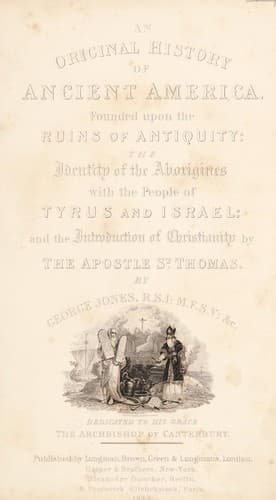
The History of Ancient America, Anterior to the Time of Columbus: Proving the Identity of the Aborigines with the Tyrians and Israelites; and the Introduction of Christianity into the Western Hemisphere By The Apostle St. ThomasJones, George
History
The History of Ancient America, Anterior to the Time of Columbus: Proving the Identity of the Aborigines with the Tyrians and Israelites; and the Introduction of Christianity into the Western Hemisphere By The Apostle St. Thomas
Jones, George
America -- Antiquities; America -- Discovery and exploration -- Phoenician; Indians -- Origin
This may be accounted for from the apparent fact, that the interior
sculpture was executed _after_ that on the outward walls; for it
appears to be far more beautiful and elaborate, and thence more time
would be required for its completion, and as a consequence, it could
only be finished at a later date; added to this a greater protection
from the weather is given to the _inside_ of quadrangular walls than
on the outside, and that without any reference to roofs or coverings:
for a strong wind striking, for instance, an easterly wall on the
outside, the force of the wind is destroyed, and consequently reaches
the opposite wall _in the area_ with a greatly diminished power. The
same argument would apply to the wind from any quarter, blowing upon
unroofed quadrangular structures, and this these builders seem to have
completely understood by making the Sculpture more refined and
delicate upon the inside.
"On one side the combination [of the Sculpture] was in the form of
diamonds, simple, chaste, and tasteful: and at the head of the
courtyard _two gigantic serpents_ (with their heads broken and fallen)
were winding from opposite directions along the whole façade"--[_i.
e._ one thousand feet].
It will be remembered that the Chief Altar at Copan has sculptured on
it _two serpents_: in the Analogies we shall endeavour to read these
wily hieroglyphics.
"In front and on a line with the door of the preceding edifice, is
another building on a lower foundation of the same general character,
called _Casa de Tortugas_, from the sculptured _turtles_ over the
doorway."
That the reader may not be misled, these "turtles" are not as defined
in Scripture (_i. e._ young doves), but the _tortoise_, the well-known
shellfish; and in the splendid illustrations of these Ruins in
Waldeck's work (folio, 1838) the _tortoise_ is distinctly given, and
without doubt is so meant by Mr. Stephens. There are _four of them_ in
a group, their heads approaching to a centre, _each tortoise_ is in a
square, and in the two external angles of each square is an _Egg_. The
_tortoise_ and _the egg_, are both National emblems, and the Nation
claiming them will be proved in the Analogies.
Public-domain text, read in full here on John Shaqi.
Reviews
Reviews
No reviews yet
Be the first to share your thoughts on this work.
Join the Discussion
Join the discussion
Sign in to leave a comment or review.
Sign InorCreate an account