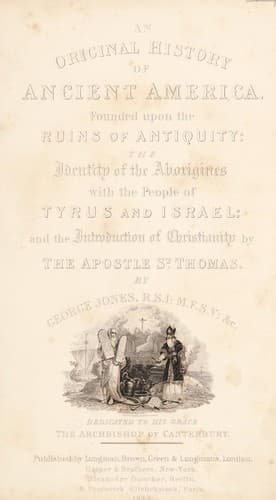
The History of Ancient America, Anterior to the Time of Columbus: Proving the Identity of the Aborigines with the Tyrians and Israelites; and the Introduction of Christianity into the Western Hemisphere By The Apostle St. ThomasJones, George
History
The History of Ancient America, Anterior to the Time of Columbus: Proving the Identity of the Aborigines with the Tyrians and Israelites; and the Introduction of Christianity into the Western Hemisphere By The Apostle St. Thomas
Jones, George
America -- Antiquities; America -- Discovery and exploration -- Phoenician; Indians -- Origin
"In the front was a broad avenue with a line of ruins on each side,
leading beyond the wall to a great mound of ruins: and beyond this a
lofty building in the rear. Between the two was a large _patio_, or
courtyard, with corridors on each side, and the ground of the
courtyard sounded hollow. In one place, the surface was broken, and I
descended into _a large excavation, cemented_, which probably had been
intended as a granary. [Rather as a _water_ reservoir] At the back of
the courtyard, on a high, broken terrace, which it was difficult to
climb, was another edifice more ruined than the others, but which from
the style of its remains, and its commanding position, overlooking
every other building [except the first described] and apparently
having been connected with the distant mass of ruins in front, must
have been one of the most important in the City, perhaps the principal
Temple. The whole presented a scene of barbaric (?) magnificence,
utterly confounding all previous notions in regard to the Aboriginal
inhabitants of this Country; and calling up emotions which had not
been wakened to the same extent by any thing we had yet seen."
"There was one strange circumstance connected with these ruins--viz.,
no water had ever been discovered, and there was not a single stream,
fountain, or well, nearer than the Hacienda, a mile and a half
distant. It is supposed that the face of the Country had not changed;
and that somewhere under ground must exist great wells, cisterns or
reservoirs [perhaps acquaducts] which supplied the former inhabitants
of the City with water." * * * * * "While I was making the circuit of
these ruins, Mr. Catherwood proceeded to the _Casa del Gobernador_; it
indicates the principal building of the old City, or _royal_ house.
(?) It _is the grandest in position_, the _most stately in
Architecture and proportions, and the most perfect in preservation_
of all the structures remaining at Uxmal."
The same argument brought forward in the last Section, to prove that
the chief edifice of Palenque was the _Temple_, and not the Palace,
will apply to this supposed "royal house." As to the phrase _"Casa del
Gobernador_"--or Governor's house,--it is the name by which it is
called in the neighbourhood, and can have no bearing upon the true
character of the edifice,--but the very superior preservation of the
building would point it to be one held Sacred from any rude assault by
the people; while its Architecture, importance of its position, and
magnitude, at once justify the name of Temple being given to this
edifice, and as such we shall view it. Mr. Stephens appears to be so
strict a Spartan Republican, that every large, or magnificent building
in the Ruined Cities, he considers to be a _Palace_,--he seems to have
thought less of mind, than of matter.
Public-domain text, read in full here on John Shaqi.
Reviews
Reviews
No reviews yet
Be the first to share your thoughts on this work.
Join the Discussion
Join the discussion
Sign in to leave a comment or review.
Sign InorCreate an account