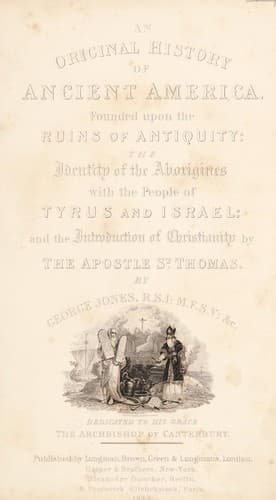
The History of Ancient America, Anterior to the Time of Columbus: Proving the Identity of the Aborigines with the Tyrians and Israelites; and the Introduction of Christianity into the Western Hemisphere By The Apostle St. ThomasJones, George
History
The History of Ancient America, Anterior to the Time of Columbus: Proving the Identity of the Aborigines with the Tyrians and Israelites; and the Introduction of Christianity into the Western Hemisphere By The Apostle St. Thomas
Jones, George
America -- Antiquities; America -- Discovery and exploration -- Phoenician; Indians -- Origin
"This edifice [Temple] stands on three ranges of terraces. The first
terrace is _six hundred and forty feet long, and five feet_ high. It
is walled with _cut stone_, and on the top is a _platform twenty feet
broad_, from which rises another terrace _fifteen feet_ high. At the
corners this terrace is supported by cut stones, having the faces
rounded so as to give a better finish than with sharp angles. The
great platform is flat. At the south-east corner of this platform is a
row of {ROUND} _pillars eighteen inches in diameter_, and three or four
feet high, [_i. e._ broken pillars] extending about one hundred feet
along the platform; and these were the _nearest approach to pillars_
or _columns_ (circular) that we saw in all our exploration of ruins of
that country."
What "nearer approach" was necessary to prove the existence of
circular columns, than his own description? Of this hereafter,--again
he writes:
"In the middle of the terrace, along an avenue leading to a range of
steps, was a _broken round pillar_, inclined and falling, and with
trees growing around it. In the centre of the platform, at a distance
of two hundred and five feet from the border in front, is a range of
stone steps, more than a hundred feet broad, and thirty-five in
number, ascending to a third terrace, fifteen feet above the last, and
thirty-five feet from the ground; which being on a naked plain, formed
a most commanding position. The erection of these terraces alone was
an immense work. _On the third terrace_, with its principal doorway
facing the range of steps, stands the noble structure. [Temple] The
façade measures _three hundred and twenty feet_. Away from the regions
of dreadful rains, and the rank growth which smothers the Ruins of
Palenque,--it stands with all its walls erect, and almost as perfect
as when deserted by the inhabitants. The _whole building is of stone_,
plain up to the moulding that runs along the tops of the doorway, and
above filled with the same rich, strange, and elaborate Sculpture;
among which is particularly conspicuous, the ornament before referred
to, as _la grecque_."
By a reference to the illustrated folio of Waldeck, it is found that
this ornament is chiefly the meander, or the Grecian square border,
used in the embroidery of the mantles and robes of Attica.
"There is no rudeness or barbarity in the design or proportions; on
the contrary, the whole wears an air of Architectural symmetry and
grandeur; and as the stranger ascends the steps, and casts a
bewildered eye along its open and desolate doors, it is hard to
believe, that he sees before him the work of a race in whose epitaph,
as written by historians,[3] they are called ignorant of Art, and said
to have perished in the rudeness of savage life."
[3] Dr. Robertson and others.
Public-domain text, read in full here on John Shaqi.
Reviews
Reviews
No reviews yet
Be the first to share your thoughts on this work.
Elsewhere in the archive
Join the Discussion
Join the discussion
Sign in to leave a comment or review.
Sign InorCreate an account