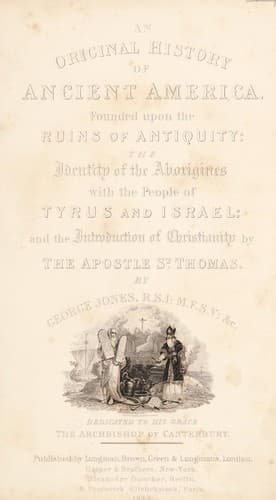
The History of Ancient America, Anterior to the Time of Columbus: Proving the Identity of the Aborigines with the Tyrians and Israelites; and the Introduction of Christianity into the Western Hemisphere By The Apostle St. ThomasJones, George
History
The History of Ancient America, Anterior to the Time of Columbus: Proving the Identity of the Aborigines with the Tyrians and Israelites; and the Introduction of Christianity into the Western Hemisphere By The Apostle St. Thomas
Jones, George
America -- Antiquities; America -- Discovery and exploration -- Phoenician; Indians -- Origin
In justice to those historians, it should be stated, that they did not
know of these architectural wonders; for if they did, no excuse can be
rendered in extenuation of such an "epitaph"--thence has arisen the
necessity of a New History of Ancient America; to, at least, the
landing of Columbus; and even that will now wear another aspect. Mr.
Stephens, in the last sentence quoted, justly reasons upon, and
correctly censures the false conclusions of those historians;--yet a
few pages before, he, himself, calls the _tout ensemble_ of the Uxmal
Ruins, with all the beautiful Sculpture, and Classical ornaments, "a
scene of _barbaric_ magnificence!" He seems afraid to combat with even
the assertions of those Historians, whose "epitaph" upon an entire
people, was written in ignorance of their works of Art. He says, "_it
is hard to believe_" that they "perished in the rudeness of savage
life,"--why, with such a gorgeous "scene" as that of Uxmal before him,
_it was an impossibility_ that they could so have perished, either in
the mind, or in history. The Ruins and Temple of Uxmal, he says,
present "a scene of _barbaric_ magnificence!" _if they do_,--either to
himself or his readers, then were Athens and the Acropolis barbaric,
and Pericles and Phidias barbarians!
"But there was one thing which seemed in strange want of conformity
with all the rest. I have mentioned that at Ocosingo [Ruins] we saw a
_wooden beam_, and at Pelanque, the remains of a wooden pole; at this
place [Uxmal] _all the lintels had been of wood, and throughout the
ruins, most of them were still in their places over the doors_. The
lintels were heavy beams, eight or nine feet long, eighteen or twenty
inches wide, and twelve or fourteen thick; the wood like that of
Ocosingo, was very hard, and rang under the blow of the machete."
From a further description, it appears that this peculiar wood was
brought from a distance of three hundred miles. Waldeck says, that it
is more durable than _lignum vitæ_, and is called by the natives
_jovillo_. The strength of this wood is thus shewn by Mr. Stephens:
"The position of these lintels was most trying, as they were obliged
to support a solid mass of stone wall, _fourteen or sixteen feet high,
and three or four feet in thickness_."
From a calculation of the measurements around the base of the
principal terrace, or pyramidal elevation, the entire distance is _two
thousand five hundred and sixty feet_. The Temple, which stands upon a
third terrace, is fronting to the East,--_i. e._ to the rising
Sun,--the chief object of Worship.
Public-domain text, read in full here on John Shaqi.
Reviews
Reviews
No reviews yet
Be the first to share your thoughts on this work.
Elsewhere in the archive
Join the Discussion
Join the discussion
Sign in to leave a comment or review.
Sign InorCreate an account