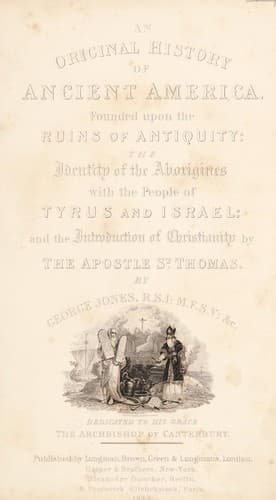
The History of Ancient America, Anterior to the Time of Columbus: Proving the Identity of the Aborigines with the Tyrians and Israelites; and the Introduction of Christianity into the Western Hemisphere By The Apostle St. ThomasJones, George
History
The History of Ancient America, Anterior to the Time of Columbus: Proving the Identity of the Aborigines with the Tyrians and Israelites; and the Introduction of Christianity into the Western Hemisphere By The Apostle St. Thomas
Jones, George
America -- Antiquities; America -- Discovery and exploration -- Phoenician; Indians -- Origin
We will now refer to his map, or ground-plan of the Temple of Uxmal,
drawn by his artist, the accurate Catherwood--(vol. ii., p. 428-9). On
that plan there are _two rows of circular columns_ in parallel
lines,--one row is perfect, and contains eleven columns, the other is
imperfect, and presents six columns; but, as dotted on the plan, and
when the parallel lines were not in ruin, contained twenty-two "round
pillars:" though from the appearance of the ground-plan, it is almost
demonstrated that the two rows of columns were continued around the
entire platform-terrace, forming a grand Colonnade, like those of
Palmyra, or that facing the church of St. Peter's at Rome, but a
square instead of a circular area. The columns at Uxmal are given as
"eighteen inches in diameter;" this multiplied by eight (the medium
calculation) would give each an altitude of twelve feet. On the plan
(by measuring from the scale given) the line of one row of the columns
extends one hundred and forty feet, its parallel the same; each column
is ten feet from its associate; the same distance exactly is between
the parallel rows, thus proving a perfect knowledge of Architectural
design! Pursuing the same scale of measurement (as the ground-plan
authorizes), the entire Colonnade of Uxmal contained originally, _two
hundred and thirty circular columns_! In the centre of the area in
front of the Temple (and holding the same locality as the single
Obelisk in front of St. Peter's, at Rome), is the ruin of the solitary
"broken round Pillar," and compared with the other columns on the Map,
is _six feet in diameter_, and this multiplied by _ten_ (for capital
and ornament on the summit,--perhaps originally an emblem of the Sun),
would give this single column an altitude of _sixty feet_! This is a
_circular_, not a square column. The foregone Architectural analysis
is not given by Stephens, but we have taken as a basis the rude
ground-plan given, and have thus resuscitated the Colonnade of Uxmal,
which formed the approach to the great Temple.[4]
[4] Upon the preceding principle, for the convenience of
reference, we have produced the following: and we predict, should
any other Cities or Ruins he discovered in Yucatan, that they will
possess the same general characteristics,--and consequently will
not injure this History,--but will rather tend to support it.
RESTORATION OF THE TEMPLE OF UXMAL, YUCATAN: _viz._--
_First Terrace_, 640 feet long on each of the four sides, 5 feet high,
steps in centre on the several sides.
_First Platform_, 20 feet broad.
_Second Terrace_, 600 feet on each of the sides, 15 feet high, steps
also in centre.
_Second Platform_, 205 feet to base of third terrace.
_Third Terrace_, 400 feet at base; 35 steps, six inches tread; entire
depth 110 feet.
_Third Platform_, 30 feet, to the front of the Temple; all the
Terraces are cased with cut stone.
_Façade_ of Temple, 320 feet: walls to first Cornice 25 feet high.
Public-domain text, read in full here on John Shaqi.
Reviews
Reviews
No reviews yet
Be the first to share your thoughts on this work.
Elsewhere in the archive
Join the Discussion
Join the discussion
Sign in to leave a comment or review.
Sign InorCreate an account