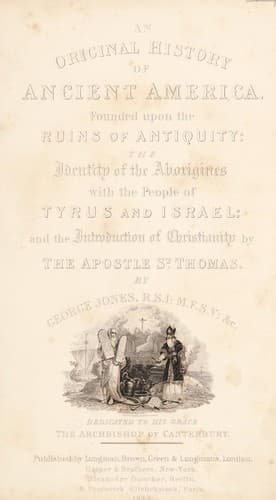
The History of Ancient America, Anterior to the Time of Columbus: Proving the Identity of the Aborigines with the Tyrians and Israelites; and the Introduction of Christianity into the Western Hemisphere By The Apostle St. ThomasJones, George
History
The History of Ancient America, Anterior to the Time of Columbus: Proving the Identity of the Aborigines with the Tyrians and Israelites; and the Introduction of Christianity into the Western Hemisphere By The Apostle St. Thomas
Jones, George
America -- Antiquities; America -- Discovery and exploration -- Phoenician; Indians -- Origin
_Three doorways_, centre, 8 feet 6 inches wide, 8 feet 10 inches
high; the two lateral doorways the same height as the centre, and 6
feet 6 inches wide.
_Colonnade_, or Second Platform, composed of 230 circular columns,
each 12 feet high, and 18 inches in diameter; in two rows; the
columns 10 feet apart.
_The Single Altar-Column_, 6 feet diameter, and 60 feet high, in
centre of area.
_Base of First Terrace_, 2560 feet!
_Sculptured walls of the Temple_, 40,960 superficial feet!
_The Three Artificial Terraces_ contain 72,800 cubic feet! G. J.
On the Map of the ruin now under consideration, and directly beneath
the "round pillars," is written the following sentence by Stephens
himself, to illustrate the meaning of the circular dots on the
plan,--the words are, "_Remains of Columns_!"
How can he then reconcile from his own descriptions, that "not one
Column has been found?" "If," says he, "this Architecture had been
derived from the Egyptians, so striking and important a feature [_i.
e._ circular Columns] would never have been thrown aside." Well then,
the "important feature" has _not_ "been thrown aside," and
consequently from his own reasoning, the Architecture was (conjoined
with the pyramidal bases) "_derived_ from the Egyptian." We believe
distinctly, that the Architecture was "derived from"--in other
words--_borrowed_ from,--the edifices of the Nile;--but, not built by
the Egyptians themselves. In regard to another branch of Art, he
commits himself in the same manner as when writing of Architecture.
"Next, as to Sculpture. The idea of resemblance in this particular has
been so often and so confidently expressed, that I almost hesitate to
declare the total want of similarity."
There should indeed be hesitation upon a subject, so capable of
denying a conclusion, directly opposed to occular demonstration.
"If there be any resemblance [to the Egyptian] at all striking, it is
only that the figures, are in _profile_, and this is equally true of
all good Sculpture in _bas-relief_."
Public-domain text, read in full here on John Shaqi.
Reviews
Reviews
No reviews yet
Be the first to share your thoughts on this work.
Elsewhere in the archive
Join the Discussion
Join the discussion
Sign in to leave a comment or review.
Sign InorCreate an account