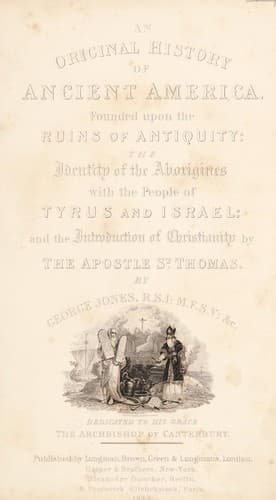
The History of Ancient America, Anterior to the Time of Columbus: Proving the Identity of the Aborigines with the Tyrians and Israelites; and the Introduction of Christianity into the Western Hemisphere By The Apostle St. ThomasJones, George
History
The History of Ancient America, Anterior to the Time of Columbus: Proving the Identity of the Aborigines with the Tyrians and Israelites; and the Introduction of Christianity into the Western Hemisphere By The Apostle St. Thomas
Jones, George
America -- Antiquities; America -- Discovery and exploration -- Phoenician; Indians -- Origin
Why does he select "_bas-relievo_" only,--why not bring forth
_alto-relievo_,--also,--for they are both found in Egypt and America.
The Altar at Copan, and the walls at Palenque present _profile_
figures and in _bas-relievo_,--so does the Vocal Memnon of Thebes,
and the walls of Egypt: at Palenque the two figures grouped at the
Altar (of Casa, No. 3) are in profile, and face to face, with the Mask
of Saturn between them, and holding the same general position as the
two figures of the Vocal Memnon,--who are also face to face, and in
profile,--but instead of the mask, they have the Egyptian Tau =T=
between them, and in the act of binding it with the lotus plant. But
he objects to similitude apparently from the want of analogy in the
physiognomy, or profile characteristics of the relative figures of
Egypt and America. This certainly then must prove that they were a
different people; this we distinctly believe;--but, that that people
had knowledge of Egyptian Architecture and Sculpture, _from commercial
intercourse with the Nile_. _Alto-Relievo_ Sculpture is in America and
Egypt:--in the former country, on the Idol-columns of Copan; in the
latter nation, upon the Capitals of the Temple Columns;--and in both
countries the faces are _not in profile_, but full front. The profile
figures being on Temples, were supposed to be _deified_, and
consequently the facial outlines were represented different from human
outline.
Again:--What are the Obelisks of Egypt? Are they not _square columns_
for the facility of Sculpture? and of what form are the isolated
columns at Copan? Are they not _square_, and for the same purpose of
facility in Sculpture with which they are covered, and with
workmanship "as fine as that of Egypt?" This is a point that Mr.
Stephens has passed over without even a comment! The Columns of Copan
stand detached and solitary,--the Obelisks of Egypt do the same, and
both are square (or four-sided) and covered with the art of the
Sculptor. The analogy of being derived from the Nile is perfect,--for
in what other Ruins but those of Egypt, and Ancient America, is the
_square sculptured Column_ to be found? He affects to despise the
Idol-Obelisks of Copan, because they do not tower in a single stone,
"ninety-feet" in height like those of Egypt,--that they could not "be
derived from" the latter country, because they are only one-sixth of
the altitude of their prototypes!
Public-domain text, read in full here on John Shaqi.
Reviews
Reviews
No reviews yet
Be the first to share your thoughts on this work.
Elsewhere in the archive
Join the Discussion
Join the discussion
Sign in to leave a comment or review.
Sign InorCreate an account