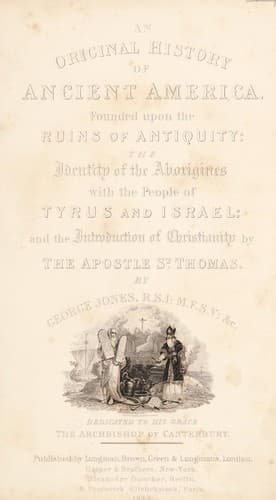
The History of Ancient America, Anterior to the Time of Columbus: Proving the Identity of the Aborigines with the Tyrians and Israelites; and the Introduction of Christianity into the Western Hemisphere By The Apostle St. ThomasJones, George
History
The History of Ancient America, Anterior to the Time of Columbus: Proving the Identity of the Aborigines with the Tyrians and Israelites; and the Introduction of Christianity into the Western Hemisphere By The Apostle St. Thomas
Jones, George
America -- Antiquities; America -- Discovery and exploration -- Phoenician; Indians -- Origin
The absence of the Arch in all the Ruins of America will, also,
identify those ancient cities with a nation having a Knowledge of, and
contemporaneous with, Egypt,--for the Arch is not to be found in the
cities of the Nile--nor was it at Sidon or Tyrus. The Arch was
invented by the Greeks, but seldom practised by them, as they did not
think it graceful,--the Romans did, and consequently used it upon
nearly every occasion. Not only does the absence of the Arch point
out Egypt as a contemporaneous nation with the builders in America,
(this is omitted by Mr. Stephens) but the manner of forming their
ceilings is distinctly imitated at Ocosingo, Palenque, and Uxmal:--for
the ceilings there are formed by stones lapping over each other (like
reversed steps) till they reach a centre, or such small distance from
each other, that a single stone will bind them. At Uxmal the ceiling
is smooth-surfaced, like a pyramidal, or gable-end ceiling. In vol.
ii., p. 313, he says, "The ceiling of each corridor was in this form.
[Described above.] _The builders were evidently ignorant of the
principles of the Arch_; and the support was made by stones lapping
over as they rose, as at Ocosingo," &c. It will be remembered that at
Palenque, the principal part of the architectural ornaments are of
_stucco_ and as "hard as stone." "The whole front [of the Temple] was
covered with _stucco_ and _painted_." The reader who may be familiar
with descriptions of the wonders of the Nile by Legh, Wilkinson, and
Belzoni, will recognise at once that "painted stucco" is also
Egyptian:--but, this comparison is avoided by Mr. Stephens; as, also,
the following artistical fact and analogy, which is found at Memphis
and other cities of Egypt--viz., "On the top of one [_i. e._ stucco
figures at Palenque] _are three hieroglyphics_ SUNK IN THE STUCCO!"
The following will not serve to support his conclusions.
"And the most radical difference of all is, the Pyramids of Egypt are
complete in themselves: the structures in this country [America] were
erected to serve as _the foundations of buildings_. There is no
pyramid in Egypt _with_ a Palace or Temple upon it, [would he have it
on an apex?]--there is no pyramidal structure in this country
_without_."
Public-domain text, read in full here on John Shaqi.
Reviews
Reviews
No reviews yet
Be the first to share your thoughts on this work.
Elsewhere in the archive
Join the Discussion
Join the discussion
Sign in to leave a comment or review.
Sign InorCreate an account