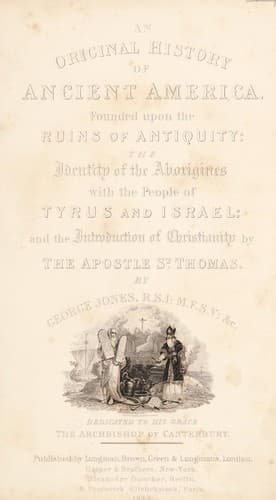
The History of Ancient America, Anterior to the Time of Columbus: Proving the Identity of the Aborigines with the Tyrians and Israelites; and the Introduction of Christianity into the Western Hemisphere By The Apostle St. ThomasJones, George
History
The History of Ancient America, Anterior to the Time of Columbus: Proving the Identity of the Aborigines with the Tyrians and Israelites; and the Introduction of Christianity into the Western Hemisphere By The Apostle St. Thomas
Jones, George
America -- Antiquities; America -- Discovery and exploration -- Phoenician; Indians -- Origin
From the foregone extract can any reader acquainted with the Arts,
fail to arrive at the conclusion, that the builders of Palenque and
Uxmal derived from the Egyptians all that was good of their great
edifices, and _improved_ upon the other parts? For what reader will
deny, that a Temple erected upon the lower portion of a Pyramid, is an
improvement upon the original, by the association of utility? And
being an improvement, _it must have been by those acquainted with the
Original_, and as remarked in the following pages, what Nation had the
facility of being so acquainted as the Tyrian? And as if in direct
copy of the Egyptian, we have shewn that the size of the pyramidal
base at Copan is identical with that of the great Pyramid of the
Nile,--while that at Cholula, in Mexican America, _is exactly twice_
the base measurement. It is scarcely possible that these dimensions
should have been accidental in construction.
"There is then," he says, "_no resemblance_ in these remains to those
of the Egyptians; _and failing here we look elsewhere in vain_."
His conclusions upon false premises, would indeed prove "no
resemblance:" but, truth and her all-powerful propositions are against
him,--his own descriptions, and those of his attendant artist crush
him at every step,--they both prove "_resemblance_" in every
Ruin;--at Copan, pyramidal structures, idol-obelisks, and sepulchral
chamber: at Palenque, profile figures, and square-based,
pyro-foundations: at Uxmal the same, with a Colonnade of circular
Columns,--and at the second city (Palenque) a stone _statue_ is even
found, and from the engraving, Egypt, or her Tyrian neighbour, would
instantly claim it. Of this statue he writes. (Vol. ii., p. 349.)
"We were at once struck with its expression of serene repose, _and its
strong resemblance to Egyptian Statues_. (!) In height it is ten feet
six inches, of which two feet six inches were under ground. The
head-dress is lofty and spreading: there are holes in [near] the place
of ears, which perhaps were adorned with ear-rings of gold and pearls.
Round the neck is a necklace: and pressed against the breast by the
right hand, is an instrument apparently with teeth."
In the wood-cut this "instrument with teeth" is no more or less, than
part of a muralled crown, and it may have been, therefore, the Statue
of the Guardian of the City. The Tyrian Coins have the muralled crown
on the head of the obverse profile, which represents Astartē, the
tutelary Goddess of the Tyrians and Sidonians.
"The left hand rests on a _hieroglyphic_, from which descends some
symbolical ornament: the figure stands on what we have always
considered a _hieroglyphic_ (plinth) _analogous again to the custom in
Egypt_ of recording the name and office of the hero, or other person
represented."
Public-domain text, read in full here on John Shaqi.
Reviews
Reviews
No reviews yet
Be the first to share your thoughts on this work.
Elsewhere in the archive
Join the Discussion
Join the discussion
Sign in to leave a comment or review.
Sign InorCreate an account