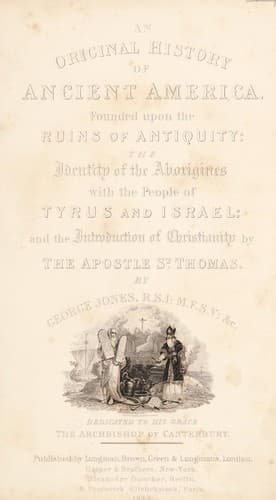
The History of Ancient America, Anterior to the Time of Columbus: Proving the Identity of the Aborigines with the Tyrians and Israelites; and the Introduction of Christianity into the Western Hemisphere By The Apostle St. ThomasJones, George
History
The History of Ancient America, Anterior to the Time of Columbus: Proving the Identity of the Aborigines with the Tyrians and Israelites; and the Introduction of Christianity into the Western Hemisphere By The Apostle St. Thomas
Jones, George
America -- Antiquities; America -- Discovery and exploration -- Phoenician; Indians -- Origin
In the last quotation but one, he distinctly uses the word
"resemblance," preceded by that of "strong," to enforce the similitude
to the Egyptian; and in the last quotation he says, that the
hieroglyphical plinth is "analogous _again_ to the custom of Egypt!"
As he has visited, and written of the statues of the Nile, we will not
gainsay his judgment even by a suspicion. The statues on the building,
surmounting the pyramidal base at Uxmal, (Waldeck's folio) strongly
resemble the general character of the Egyptian,--the head-dress and
cape especially,--the difference is, that otherwise than the lappet,
hood, and cape,--the figure is entirely naked,--whereas the Egyptian
statues generally possess the additional costume of the loin-cloth.
"They [the Ruins] are different from the works of any other _known
people_, of a _new order_, and entirely and absolutely anomalous: they
stand alone."
Every people (he argues) and the nations known at the present day, by
history, _or by ruins_, have been searched in order to identify by
_fac-simile_ resemblance, but in vain,--though Egypt, we have shewn,
claims the bases and many attendant analogies. What Nation then ever
existed (possessing _navigable_ means) of whose works by Architecture
and Sculpture we have no knowledge?--"That is the question,"--and that
answered, it will aid the solving of the mysterious problem around the
_Ruins_. Then here is the answer, without any fear of contradiction
or denial. _The only nation is the Tyrian!_--that name is used in its
triple or Phœnician sense, and comprehends Sidon, Tyrus, and
Carthage,--not a remnant remains whereby the slightest form can be
traced, save the mere foundations of their former greatness! Egypt was
the neighbour of the Tyrian, and consequently imparted her knowledge
through commercial communion.
The inhabitants of Tyrus from their small locality [_i. e._ the
Island] were essentially a practical people,--they had no space to
build idle or useless edifices, like those of Egypt,--_they had no
captives_! The Tyrians were of all people of the ancient world, best
adapted to imitate what was of utility and stability,--thence their
selecting pyramidal bases, as _foundations_ for their Temples in
America, and which have preserved those edifices, and the judgment of
the builders, even to this day, through a period of time beyond two
thousand years! It also evinced that acuteness and skill, in applying
means to ends, for which, as a Nation, they were so renowned. In
Section 3, of the Analogies, we will establish from Scriptural History
the early Architecture (as to its style) of the ancient Tyrians.
Public-domain text, read in full here on John Shaqi.
Reviews
Reviews
No reviews yet
Be the first to share your thoughts on this work.
Elsewhere in the archive
Join the Discussion
Join the discussion
Sign in to leave a comment or review.
Sign InorCreate an account