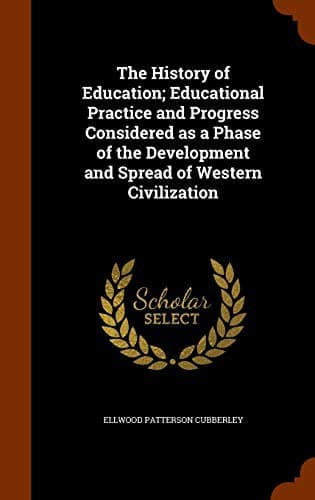
The History of Education: Educational Practice and Progress Considered as a Phase of the Development and Spread of Western CivilizationCubberley, Ellwood Patterson
History
The History of Education: Educational Practice and Progress Considered as a Phase of the Development and Spread of Western Civilization
Cubberley, Ellwood Patterson
Education -- History
The most powerful force with which the barbarians came in contact, though,
and the one which did most to reduce them to civilization, was the
Christian Church. Organized, as we have seen, after the Roman governmental
model, and as a State within a State, the Church gained in strength as the
Roman government grew weaker, and was ready to assume governmental
authority when Rome could no longer exert it. The barbarians here
encountered an organization stronger than force and greater than kings,
[9] which they must either accept and make terms with or absolutely
destroy. As all the tribes, though heathen, possessed some form of spirit
or nature worship or heathen gods, which served as a basis for
understanding the appeal of the Church, the result was the ultimate
victory, and the Christianizing, in name at least, of all the barbarian
tribes. This was the first step in the long process of civilizing and
educating them.
THE IMPRESS OF CHRISTIANITY UPON THEM. The importance of the services
rendered by bishops, priests, and monks during what are known as the _Dark
Ages_ can hardly be overestimated. In the face of might they upheld the
right of the Church and its representatives to command obedience and
respect. [10] The Christian priest gradually forced the barbarian chief to
do his will, though at times he refused to be awed into submission,
murdered the priest, and sacked the sacred edifice. That the Church lost
much of its early purity of worship, and adopted many practices fitted to
the needs of the time, but not consistent with real religion, there can be
no question. In time the Church gained much from the mixture of these new
peoples among the old, as they infused new vigor and energy into the blood
of the old races, but the immediate effect was quite otherwise. The Church
itself was paganized, but the barbarians were in time Christianized.
Priests and missionaries went among the heathen tribes and labored for
their conversion. Of course the leaders were sought out first, and often
the conversion of a chieftain was made by first converting his wife. After
the chieftain had been won the minor leaders in time followed. The lesson
of the cross was proclaimed, and the softening and restraining influences
of the Christian faith were exerted on the barbarian. It was, however, a
long and weary road to restore even a semblance of the order and respect
for life and property which had prevailed under Roman rule.
Public-domain text, read in full here on John Shaqi.
Reviews
Reviews
No reviews yet
Be the first to share your thoughts on this work.
Elsewhere in the archive
Join the Discussion
Join the discussion
Sign in to leave a comment or review.
Sign InorCreate an account