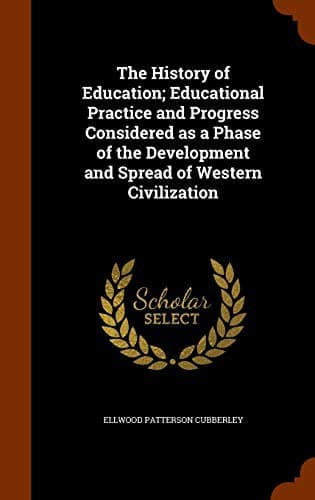
The History of Education: Educational Practice and Progress Considered as a Phase of the Development and Spread of Western CivilizationCubberley, Ellwood Patterson
History
The History of Education: Educational Practice and Progress Considered as a Phase of the Development and Spread of Western Civilization
Cubberley, Ellwood Patterson
Education -- History
THE ELEVENTH CENTURY A TURNING POINT. By the end of the eleventh century a
distinct turning-point had been reached in the struggle to save
civilization from perishing. From this time on it was clear that the
battle had been won, and that a new Christian civilization would in time
arise in western Europe. Much still remained to be done, and centuries of
effort would be required, but the Church, almost for the first time in
more than six hundred years, felt that it could now pause to organize and
systematize its faith. The invasions and destruction of the Northmen had
at last ceased, the Mohammedan conquests were over, almost the last of the
Germanic tribes in Europe had settled down and had accepted Christianity,
[8] and the fighting nobility of Europe were being held somewhat in
restraint by the might of the Church, the "Truce of God" (R. 79), and the
softening influence of chivalric education (R. 80). There were many
evidences, too, by the end of the eleventh century, that the western
Christian world, after the long intellectual night, was soon to awaken to
a new intellectual life. The twelfth century, in particular, was a period
when it was evident that some new leaven was at work.
Up to about the close of the eleventh century western Europe had been
living in an age of simple faith. The Christian world everywhere lay under
"a veil of faith, illusion, and childish prepossession." The mysteries of
Christianity and the many inconsistencies of its teachings and beliefs
were accepted with childlike docility, and the Church had felt little call
to organize, to systematize, or to explain. Here and there, to be sure,
some questioning monk or cleric had raised questions over matters [9] of
faith which his reason could not explain, and had, perhaps, for a time
disturbed the peace of orthodoxy, but a statement somewhat similar to that
made by Anselm of Canterbury (footnote, p. 173), as to the precedence of
faith over reason, had usually been sufficient to silence all inquiry.
Once, in the latter part of the eleventh century, when a great discussion
as to the nature of knowledge had taken place among the leaders of the
Church, a church council had been called to pass upon and give final
settlement to the questions raised. [10]
Public-domain text, read in full here on John Shaqi.
Reviews
Reviews
No reviews yet
Be the first to share your thoughts on this work.
Elsewhere in the archive
Join the Discussion
Join the discussion
Sign in to leave a comment or review.
Sign InorCreate an account