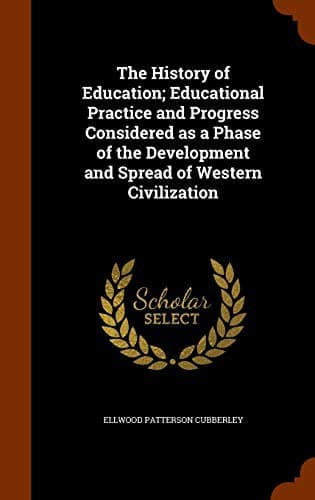
The History of Education: Educational Practice and Progress Considered as a Phase of the Development and Spread of Western Civilization — John Shaqi
The History of Education: Educational Practice and Progress Considered as a Phase of the Development and Spread of Western CivilizationCubberley, Ellwood Patterson
History
The History of Education: Educational Practice and Progress Considered as a Phase of the Development and Spread of Western Civilization
Cubberley, Ellwood Patterson
Education -- History
By making the works of the great poets of the Greek people the material of
their education, the Athenians attained a variety of objects difficult of
attainment by any other one means. The fact is, the ancient poetry of
Greece, with its finished form, its heroic tales and characters, its
accounts of peoples far removed in time and space, its manliness and
pathos, its directness and simplicity, its piety and wisdom, its respect
for law and order, combined with its admiration for personal initiative
and worth, furnished, in the hands of a careful and genial teacher, a
material for a complete education such as could not well be matched even
in our own day. What instruction in ethics, politics, social life, and
manly bearing could not find a fitting vehicle in the Homeric poems, not
to speak of the geography, the grammar, the literary criticism, and the
history which the comprehension of them involved? Into what a wholesome,
unsentimental, free world did these poems introduce the imaginative Greek
boy! What splendid ideals of manhood and womanhood did they hold up for
his admiration and imitation! From Hesiod he would learn all that he
needed to know about his gods and their relation to him and his people.
From the elegiac poets he would derive a fund of political and social
wisdom, and an impetus to patriotism, which would go far to make him a
good man and a good citizen. From the iambic poets he would learn to
express with energy his indignation at meanness, feebleness, wrong, and
tyranny, while from the lyric poets he would learn the language suitable
to every genial feeling and impulse of the human heart. And in reciting or
singing all these, how would his power of terse, idiomatic expression, his
sense of poetic beauty and his ear for rhythm and music be developed! With
what a treasure of examples of every virtue and vice, and with what a fund
of epigrammatic expression would his memory be furnished! How familiar he
would be with the character and ideals of his nation, how deeply in
sympathy with them! And all this was possible even before the introduction
of letters. With this event a new era in education begins. The boy now not
only learns and declaims his Homer, and sings his Simonides or Sappho; he
learns also to write down their verses from dictation, and so at once to
read and to write. This, indeed, was the way in which these two (to us)
fundamental arts were acquired. As soon as the boy could trace with his
finger in sand, or scratch with a stylus on wax, the forms of the letters,
and combine them into syllables and words, he began to write poetry from
his master's dictation. The writing-lesson of to-day was the reading,
recitation, or singing-lesson of to-morrow. Every boy made his own reading
book, and, if he found it illegible, and stumbled in reading, he had only
himself to blame. The Greeks, and especially the Athenians, laid the
greatest stress on reading well, reciting well, and singing well, and the
Public-domain text, read in full here on John Shaqi.
Reviews
Reviews
No reviews yet
Be the first to share your thoughts on this work.
Join the Discussion
Join the discussion
Sign in to leave a comment or review.
Sign InorCreate an account