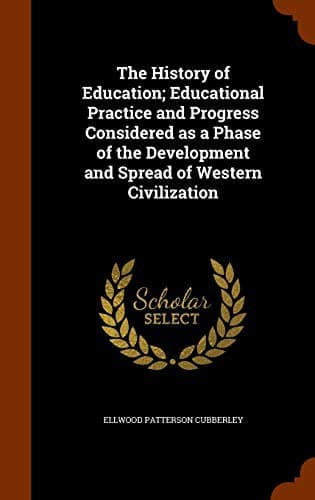
The History of Education: Educational Practice and Progress Considered as a Phase of the Development and Spread of Western CivilizationCubberley, Ellwood Patterson
History
The History of Education: Educational Practice and Progress Considered as a Phase of the Development and Spread of Western Civilization
Cubberley, Ellwood Patterson
Education -- History
Abbott, F. F. _Society and Politics in Ancient Rome_.
* Adams, G. B. _Civilization during the Middle Ages_.
Anderson, L. F. "Some Facts regarding Vocational Education among the
Greeks and Romans"; in _School Review_, vol. 20, pp. 191-201.
* Clarke, Geo. _Education of Children at Rome_.
* Dill, Sam'l. _Roman Society in the Last Century of the Western
Empire_.
* Laurie, S. S. _Historical Survey of Pre-Christian Education_.
Mahaffy, J. P. _The Silver Age of the Greek World_.
Ross, C. F. "The Strength and Weakness of Roman Education"; in
_School and Society_, vol. 6, pp. 457-63.
Sandys, J. E. _History of Classical Scholarship_, vol. i.
Thorndike, Lynn. _History of Mediaeval Europe_.
Westermann, W. L. Vocational Training in Antiquity; in _School
Review_, vol. 22, pp. 601-10.
CHAPTER IV
THE RISE AND CONTRIBUTION OF CHRISTIANITY
I. THE RISE AND VICTORY OF CHRISTIANITY
RELIGIONS IN THE ROMAN WORLD. As was stated in the preceding chapter (p.
58), the Roman state religion was an outgrowth of the religion of the
home. Just as there had been a number of fireside deities, who were
supposed to preside over the different activities of the home, so there
were many state deities who were supposed to preside over the different
activities of the State. In addition, the Romans exhibited toward the
religions of all other peoples that same tolerance and willingness to
borrow which they exhibited in so many other matters. Certain Greek
deities were taken over and temples erected to them in Rome, and new
deities, to guard over such functions as health, fortune, peace, concord,
sowing, reaping, etc., were established. [1] Extreme tolerance also was
shown toward the special religions of other peoples who had been brought
within the Empire, and certain oriental divinities had even been admitted
and given their place in Rome.
Like many other features of Roman life, their religion was essentially of
a practical nature, dealing with the affairs of everyday life, and having
little or no relation to personal morality. [2] It promised no rewards or
punishments or hopes for a future life, but rather, by uniting all
citizens in a common reverence and fear of certain deities, helped to
unify the Empire and hold it together. After the death of Augustus (14
A.D.), the Roman Senate deified the Emperor and enrolled his name among
the gods, and Emperor worship was added to their ceremonies. This
naturally spread rapidly throughout the Empire, tended to unite all
classes in allegiance to the central government at Rome, and seemed to
form the basis for a universal religion for a universal empire.
Public-domain text, read in full here on John Shaqi.
Reviews
Reviews
No reviews yet
Be the first to share your thoughts on this work.
Elsewhere in the archive
Join the Discussion
Join the discussion
Sign in to leave a comment or review.
Sign InorCreate an account