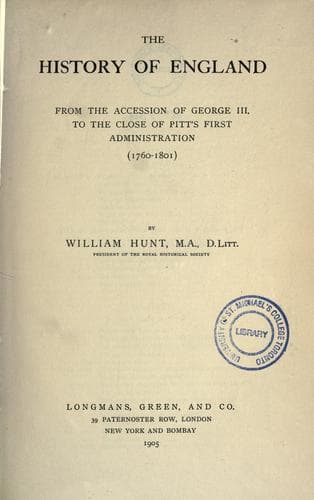
The history of England, from the accession of George III. to the close of Pitt's first administration, 1760-1801Hunt, William
History
The history of England, from the accession of George III. to the close of Pitt's first administration, 1760-1801
Hunt, William
Great Britain -- History -- George III, 1760-1820
Mir Jafar was again made nawab, and paid large sums both to the company
and its servants as compensation for their losses. The war, however, was
not over, for the nawab wazir espoused the cause of Mir Kasim, and, in
conjunction with the Mughal emperor, Shah Alam, threatened Bengal. Major
Hector Munro took command of the British army, and found it in a
mutinous condition; desertions to the enemy were frequent. He captured a
large body of deserters, caused twenty-four of the ringleaders to be
blown from guns, and by his dauntless conduct restored discipline among
the troops. With about 7,000 men, of whom only some 1,000 were
Europeans, he inflicted a crushing defeat on the allied forces, 50,000
strong, at Baxar on October 23, 1764. The enemy lost 6,000 men and 167
guns. Oudh lay at the disposal of the English, and Shah Alam sought
refuge with the conquerors. Early in 1765 Mir Jafar died, and the
council at Calcutta, without consulting the emperor, appointed his son
to succeed him, receiving in presents from him L139,357, besides money
unaccounted for. These revolutions and wars cost the company much money,
and, while its servants were enriching themselves, it incurred heavy
debts. Clive was called upon to put an end to the maladministration of
Bengal. He refused to return to India while Sullivan was chairman of the
court of directors. After a sharp contest, in which large sums were
spent, the proprietors put his party in power. He was invested with full
authority as commander-in-chief and governor of Bengal to act in
conjunction with a select committee.
He landed in India in May, 1765. During his administration of about
eighteen months he secured for the company the virtual sovereignty over
its conquests without dispossessing the nominal rulers, and he took
measures for the reformation of the company's service. Averse from a
forward policy of conquest, he restored Oudh to the nawab wazir on
payment of L500,000. Allahabad and Kora were assigned to the emperor,
together with a tribute from Bengal, and in return Shah Alam granted to
the company the right of levying and administering the revenues of
Bengal, Behar, and Orissa, together with jurisdiction in the Northern
Circars. The nawab of Bengal received an annual pension of L600,000, and
surrendered all his power to the company, except the right of criminal
jurisdiction. Clive reorganised the army, and stopped the double
_batta_, or allowance, granted by Mir Jafar after the battle of Plassey.
He forbade illicit trade and the receipt of presents, and secured the
company's servants increased salaries. These reforms were effected in
the face of violent opposition, both in civil and military quarters. Two
hundred officers conspired to resign their commissions on the same day.
Clive faced the mutiny successfully; he cashiered the leaders and
accepted the submission of the younger men. Ill-health obliged him to
return to England in January, 1767.
[Sidenote: _AFFAIRS OF THE EAST INDIA COMPANY._]
Public-domain text, read in full here on John Shaqi.
Reviews
Reviews
No reviews yet
Be the first to share your thoughts on this work.
Elsewhere in the archive
Join the Discussion
Join the discussion
Sign in to leave a comment or review.
Sign InorCreate an account