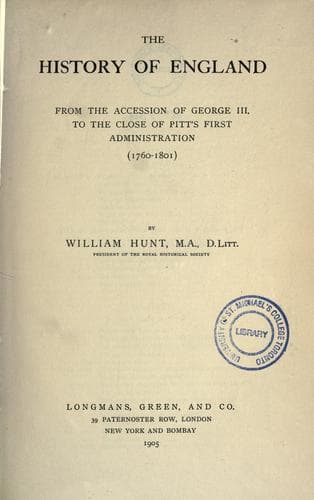
The history of England, from the accession of George III. to the close of Pitt's first administration, 1760-1801Hunt, William
History
The history of England, from the accession of George III. to the close of Pitt's first administration, 1760-1801
Hunt, William
Great Britain -- History -- George III, 1760-1820
The enormous private fortunes made in India led people to believe that
the company was far richer than it really was. During the late wars the
dividend was 6 per cent. In 1766 the proprietors urged an increase. To
this the directors objected that the debts of the company were heavy,
and that a premature increase would raise the price of stock to a point
at which it could not be maintained, and might end in a disaster like
that of the South Sea Company. The ministers sent a message of warning,
announcing that the affairs of the company would probably be considered
in parliament. They concerned the public, for the company enjoyed
protection and privileges granted by the nation. Nevertheless the
proprietors carried their point, and a dividend of 10 per cent. was
declared. Chatham held that the time had come for parliament to inquire
by what right the company administered its territorial revenues. He
considered that it had no right to its new position of a virtually
sovereign power, that the sovereignty of the crown should be asserted,
and that in return for the privileges which it enjoyed it should
contribute a portion of its revenues to the national treasury. The
company should apply to parliament to make good its defective title, and
parliament should then settle what portion of its revenues should be
assigned to it by way of favour. His ideas were based on an imperial
policy. As early as 1759 he held that the territorial acquisitions of
the company should be claimed for the nation. With him it was a matter
not merely of revenue but of government, and though his ideas are
indistinctly indicated, and were perhaps vaguely formed, it is probable
that he had in his mind some idea of making the government of India an
imperial matter. Yet, sharing as he did the general belief as to the
wealth of the company, he certainly attached much importance to the
possibility of obtaining from it an increase of the public revenue.
Public-domain text, read in full here on John Shaqi.
Reviews
Reviews
No reviews yet
Be the first to share your thoughts on this work.
Elsewhere in the archive
Join the Discussion
Join the discussion
Sign in to leave a comment or review.
Sign InorCreate an account