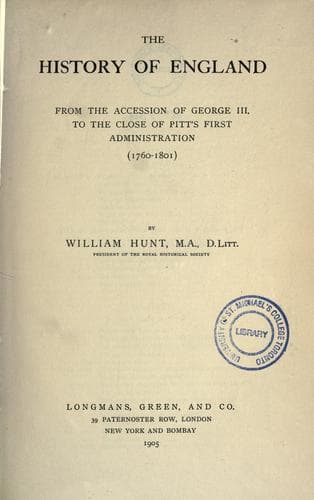
The history of England, from the accession of George III. to the close of Pitt's first administration, 1760-1801Hunt, William
History
The history of England, from the accession of George III. to the close of Pitt's first administration, 1760-1801
Hunt, William
Great Britain -- History -- George III, 1760-1820
The new duties were external taxes, taxes on trade, such as the
colonists had professed themselves prepared to pay, and they were
trifling in amount, their produce being estimated at less than L40,000.
But they were imposed for purposes of revenue, not for the regulation of
trade, which would in Chatham's eyes have rendered them a rightful
imposition. And the colonists' position had changed. They demanded to be
taxed only by their own assemblies, and regarded the new acts as laying
the foundation of a fiscal system which would probably be as liable to
abuse as the Irish civil list. A renewal of the rumour concerning a
colonial episcopate increased their suspicion as to the height to which
demands on their purse might grow. Their discontent was originally
founded on their impatience of control and on the restraints placed upon
their industry and commerce; their resistance was roused by the fear of
future ill-government rather than by actual grievances. The quarrel
became embittered by faults on both sides. By denying the authority of
parliament and contemning the prerogative, the Americans took up a
position which could not be conceded to them without national
humiliation; they irritated the English by violent words and actions,
and treated the loyalists with injustice and cruelty. On the other hand,
England, besides imposing restrictions on their industry and commerce,
made demands upon them which, though just, were galling to their spirit.
As they had representative assemblies, they argued that they should be
taxed only by their authority. The king and the nation generally had no
sympathy with their complaints and were unconciliatory.
[Sidenote: _CHATHAM'S ILLNESS._]
Yet while there were faults on both sides, both alike showed a spirit
worthy of their common stock, the colonists by their insistence on
self-government, the mother-country by its steadfast adherence to the
imperial idea as it then existed. Massachusetts again took the lead in
resistance; the merchants renewed the non-importation agreements, and
the assembly sent a petition to the king, and on February 11, 1768, a
circular letter to the other provincial assemblies condemning the late
acts and inviting co-operation. This letter, the work of Samuel Adams,
did much to remove the jealousies between the provinces and to arouse a
spirit of union. It evoked expressions of sympathy from Virginia and
other colonies, and the merchants of New York at once joined the
Bostonians in a system of non-importation. Of almost equal importance
were _The Farmer's Letters_ by Dickinson, which appeared in a
Pennsylvania paper in 1767-68, and contained an able statement of the
claims of colonies, recommending a firm but peaceable attitude of
resistance. Meanwhile the condition of the ministry was unfavourable
alike to any chance of conciliation or to a consistently vigorous
policy.
Public-domain text, read in full here on John Shaqi.
Reviews
Reviews
No reviews yet
Be the first to share your thoughts on this work.
Elsewhere in the archive
Join the Discussion
Join the discussion
Sign in to leave a comment or review.
Sign InorCreate an account