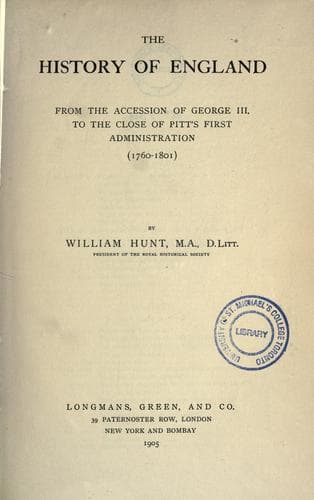
The history of England, from the accession of George III. to the close of Pitt's first administration, 1760-1801Hunt, William
History
The history of England, from the accession of George III. to the close of Pitt's first administration, 1760-1801
Hunt, William
Great Britain -- History -- George III, 1760-1820
Money was wanted for the service of the country, and specially for the
maintenance of the navy, and a month later Townshend proposed that the
land tax should be continued at four shillings in the pound. A strong
opposition was expected, for the country gentlemen reasonably contended
that the tax had been raised from three to four shillings as a war-tax,
that it was time to lower it, and that if the stamp act had not been
repealed it might be reduced to its normal amount.[77] The whigs, whose
economic policy was directed by their desire to increase the wealth and
power of the nation by promoting trade, held that the larger share of
taxation should be drawn from the land, and fostered the agricultural
interest in order to enable it to bear the disproportionate burden they
laid upon it. Nevertheless, the Rockingham and Grenville parties took
advantage of the dissatisfaction of the landed gentry, acted together in
a factious spirit, and defeated the government proposal by 206 votes to
188. This was a serious blow to the government, and was the first
occasion on which a minister had been defeated on a money-bill since the
revolution. The defeat was due to Townshend's neglect. Chatham would no
longer bear with him, and one of his last acts before his retirement was
to invite Lord North, the eldest son of the Earl of Guilford, to take
his place as chancellor of the exchequer. North refused, and Townshend
remained in office. He had to raise money somehow, and he was kept in
mind of his pledge with regard to America; for parliament was indignant
at the conduct of the New York assembly, and the court party urged him
on by representing that the king was humiliated by the repeal of the
stamp act. In June he carried two bills affecting the colonies, one
providing for the execution of the trade laws, the other imposing duties
on the importation of glass, paper, paints, and tea. The produce of
these duties was to be applied, first, to the cost of administering
justice and of the civil government, and the surplus was to be paid into
the exchequer and appropriated by parliament to the defence of the
colonies. The bills passed without opposition and the acts came into
operation on November 20. A bill was also passed suspending the
legislative power of the New York assembly, until it should comply with
the mutiny act.
Public-domain text, read in full here on John Shaqi.
Reviews
Reviews
No reviews yet
Be the first to share your thoughts on this work.
Elsewhere in the archive
Join the Discussion
Join the discussion
Sign in to leave a comment or review.
Sign InorCreate an account