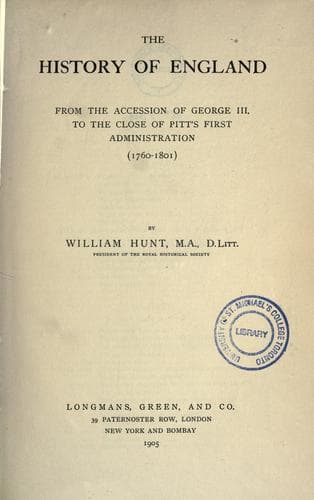
The history of England, from the accession of George III. to the close of Pitt's first administration, 1760-1801Hunt, William
History
The history of England, from the accession of George III. to the close of Pitt's first administration, 1760-1801
Hunt, William
Great Britain -- History -- George III, 1760-1820
The ministry showed its bias by its action with reference to a dispute
between the two chief magnates in Cumberland and Westmorland, the Duke
of Portland, a prominent member of the Rockingham party, and Sir James
Lowther, Bute's son-in-law, who commanded nine seats in the house of
commons. The duke's estate in the north came to him by a grant from
William III. to the first Earl of Portland, in virtue of which he held
the forest of Inglewood and the socage of Carlisle, valued at about
L30,000, as appurtenances to the estate expressly granted. Lowther
contended that the grant did not convey these appurtenances and applied
to the treasury for a lease of them. Without officially informing the
duke of his claim, the treasury granted the lease. As between subject
and subject the duke's title would have been indisputable, for his house
had had undisturbed possession for over sixty years, but as regards
claims of the crown there was an ancient maxim: _Nullum tempus occurrit
regi_--"Time does not bar the king's rights". The attempt of the
treasury to revive this maxim was considered oppressive, and was
generally attributed to the influence of Bute and the court, and to a
desire to injure a political opponent and gratify a powerful supporter.
The feeling was strengthened by the characters of the two disputants,
for Portland was a man of high reputation, Lowther a cynical tyrant. On
February 17, 1768, Sir George Savile, a great Yorkshire landowner and a
member of the Rockingham party, whose integrity and wealth gave him
weight in the house, brought in a bill called the _Nullum tempus_ bill,
to make sixty years' possession a bar to claims of the crown. It was
opposed by the ministry, and North succeeded in adjourning the motion,
though only by 134 to 114. Parliament was dissolved in March, and the
new parliament passed the bill.
Public-domain text, read in full here on John Shaqi.
Reviews
Reviews
No reviews yet
Be the first to share your thoughts on this work.
Elsewhere in the archive
Join the Discussion
Join the discussion
Sign in to leave a comment or review.
Sign InorCreate an account