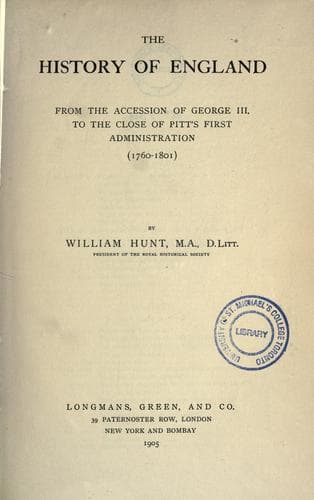
The history of England, from the accession of George III. to the close of Pitt's first administration, 1760-1801Hunt, William
History
The history of England, from the accession of George III. to the close of Pitt's first administration, 1760-1801
Hunt, William
Great Britain -- History -- George III, 1760-1820
The union with the Bedford party lessened any chance of American
conciliation. Hillsborough ordered the Massachusetts assembly to rescind
its circular letter. It refused, and, acting on Hillsborough's
instructions, Bernard dissolved the assembly. Other colonies rejected
the command to disregard the letter; they would stand or fall with
Massachusetts. In New York, however, the "whig party" was defeated at
the elections, the assembly complied with the mutiny act, and its
legislative authority was restored. Bernard sent home disquieting
reports; the revenue laws were openly defied, and the officers forcibly
prevented from executing them; he was himself insulted by the mob, and
had not, he wrote, "the shadow of authority". There were no troops
nearer than New York. Bernard, an upright and fairly able man, though
too apt to dispute with his disputatious opponents, was extremely
unpopular, for it was known that he advised the ministers to take strong
measures. It was his duty to represent the royal authority and to
maintain the laws, and he told them that he could do nothing unless he
was supported. He was right. Between a frank surrender and a vigorous
and consistent policy there should have been no middle way. The
ministers found one. They irritated the Americans without attempting to
crush the fomenters of disturbance; they threatened and retreated, made
a demonstration of force and shrank from employing it; their threats
made the British government hated, their lenity brought it into
contempt.[79] Bernard, of course, wrote as a partisan, but with this
allowance his reports may be accepted as trustworthy.
Acting on these reports, Hillsborough, early in June, 1768, ordered Gage
to send troops to Boston to protect the king's officers. It was full
time. On the 10th a sloop belonging to Hancock, a merchant of Boston,
arrived in the harbour laden with wine from Madeira. The tide-waiter
who boarded her was forcibly detained, and an attempt was made to
defraud the revenue by a false declaration. On this the commissioners
seized the sloop and laid her under the stem of the _Romney_, a
man-of-war, in the harbour. A riot ensued; the revenue officers were
mobbed, one of their boats was burned, and they were forced to take
refuge in the castle. On September 29 seven ships carrying the 14th and
29th regiments, and a company of artillery, in all about 1,000 men,
arrived in the harbour. The Bostonians refused to assign quarters for
the troops, and they suffered some hardships. On receiving the news of
the riot in June the ministers despatched the 64th and 65th regiments to
Boston. These reinforcements arrived in January, 1769. The people were
indignant; but in the face of so large a force remained quiet.
[Sidenote: _CHATHAM RESIGNS OFFICE._]
Public-domain text, read in full here on John Shaqi.
Reviews
Reviews
No reviews yet
Be the first to share your thoughts on this work.
Elsewhere in the archive
Join the Discussion
Join the discussion
Sign in to leave a comment or review.
Sign InorCreate an account