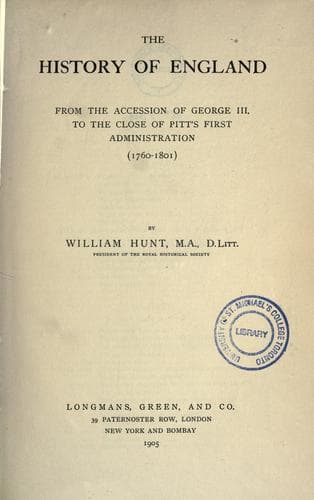
The history of England, from the accession of George III. to the close of Pitt's first administration, 1760-1801Hunt, William
History
The history of England, from the accession of George III. to the close of Pitt's first administration, 1760-1801
Hunt, William
Great Britain -- History -- George III, 1760-1820
On American, as well as on other measures, Shelburne, who desired
conciliation, differed from his colleagues. In the autumn of 1768 the
king and the Bedford party urged his dismissal, and Grafton acquiesced.
Chatham was annoyed by this decision, and still more by the dismissal of
Sir Jeffrey Amherst, governor of Virginia. He resigned the privy seal in
October, and Grafton was thenceforward considered as head of the
ministry. A few days later Shelburne resigned. He was generally disliked
and distrusted. He had acted as a go-between in the early days of his
career, and while in office was believed to be false to his colleagues;
his face answered to the popular idea of a Jesuit, and his manners were
artificial. He was given the nickname of Malagrida, a Portuguese Jesuit
who had been executed for conspiracy in 1761. Weymouth took his place in
the southern, and Lord Rochford became secretary of state for the
northern department. When parliament met in December, Bedford moved a
petition to the crown to apply to Massachusetts an act of 35 Henry
VIII., by which offenders outside the kingdom were liable to be brought
to England for trial. This motion and eight resolutions on American
affairs moved by Hillsborough passed both houses without a division,
though not without opposition, the cause of the colonists being
advocated in the commons by Pownall, an ex-governor of Massachusetts,
Burke, and others.
To recommend the revival of an obsolete statute, made in a tyrannical
reign and to meet different circumstances, in order to enable a
government to deport offenders from a distant colony and try them by
juries certain to be prejudiced against them, was so contrary to the
spirit of the constitution as to be defensible only on the ground of
necessity. That it would have been impossible to secure a verdict in the
province against a rioter can scarcely be doubted. The government,
however, advocated this measure, not because it was necessary, but
merely to frighten the colonists. This became known in America, and the
colonists learned that England had made an empty threat, and was about
to adopt a conciliatory policy. The only effect of the threat was to
excite Virginia and North Carolina to non-importation. The
non-importation agreements, which were enforced by advertising the names
of offending tradesmen, caused heavy loss to British trade. Between
Christmas 1767 and 1769 the value of exports to America decreased by
about L700,000. The cabinet inclined to conciliatory measures, and the
Massachusetts assembly was again summoned, though it professed no regret
for its past conduct. On May 1, 1769, the cabinet resolved to bring in a
bill during the next session for taking off all the new duties except
that on tea. Grafton proposed to give them all up, and was supported by
Camden, Conway, and Granby. North was inclined to a total repeal, but
yielded to the king's influence, and declared for retaining the tea duty
Public-domain text, read in full here on John Shaqi.
Reviews
Reviews
No reviews yet
Be the first to share your thoughts on this work.
Elsewhere in the archive
Join the Discussion
Join the discussion
Sign in to leave a comment or review.
Sign InorCreate an account