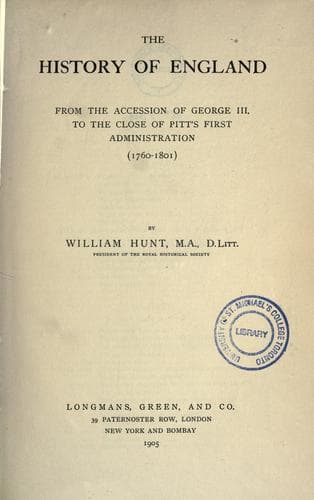
The history of England, from the accession of George III. to the close of Pitt's first administration, 1760-1801Hunt, William
History
The history of England, from the accession of George III. to the close of Pitt's first administration, 1760-1801
Hunt, William
Great Britain -- History -- George III, 1760-1820
In Irish, not less than in American, affairs the policy of the ministry
was decided by the king. Ireland was governed as a subject country. Shut
out from the benefits of the navigation laws, she was only allowed such
commerce as would not bring her into rivalry with England. Since the
beginning of the century the condition of her people had slightly
improved, but in Munster and Connaught there was much terrible misery.
Though the severest provisions of the penal code were obsolete, the
protestants still remained a dominant caste. Roman catholics were shut
out from the bar and the army, and the sons of catholic squires for the
most part either spent their youth in idleness or served in foreign
armies. The great landowners were generally absentees and their estates
were rented by middle-men; the lands were let three or four deep, and
the peasants were crushed by exorbitant rents and unjust dealing. Their
burdens were increased by the tithe paid to an alien Church which was
still rather a secular than a religious power and, though more Irishmen
held preferments in it than formerly, had no place in the affections of
the people and neglected its duty, while the catholic priests, mostly
poor and ignorant men, were active, were adored by their flocks, and
ruled them with benevolent despotism. The tithe was specially burdensome
to the poor, both because the rich pasture-lands of the wealthy were
exempt from payment, while it was levied on little plots worked by the
plough or spade of the peasant, and because it was constantly farmed out
to men who made their bargains profitable by oppressing the needy with
unfair exactions. Chief among the causes of the misery of the peasants
was the extent to which arable land was converted into pasture. Commons
were unjustly enclosed, villages were depopulated, the starving peasants
were forced to flee to the mountains, and black cattle roamed at will
round the ruins of their deserted dwellings.
Public-domain text, read in full here on John Shaqi.
Reviews
Reviews
No reviews yet
Be the first to share your thoughts on this work.
Elsewhere in the archive
Join the Discussion
Join the discussion
Sign in to leave a comment or review.
Sign InorCreate an account