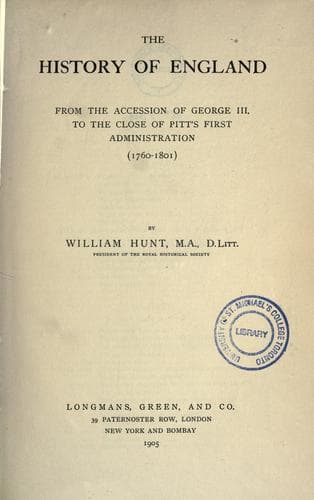
The history of England, from the accession of George III. to the close of Pitt's first administration, 1760-1801Hunt, William
History
The history of England, from the accession of George III. to the close of Pitt's first administration, 1760-1801
Hunt, William
Great Britain -- History -- George III, 1760-1820
The despair of the wretched found expression in violence. In 1761 a
secret society called the Whiteboys was organised in Munster and parts
of Leinster to resist, or exact vengeance for, the enclosure of commons,
and unjust rents or tithe. The movement was agrarian, not religious,
though the Whiteboys were catholics, nor political. It was formidable,
for there was no Irish constabulary or militia. The Whiteboys would
gather in obedience to some secret mandate, march by night in large and
ordered companies, some to the land of one offender, others to that of
another, and, making the darkness hideous with their white smocks, fall
to houghing cattle, destroying fences, and spoiling pastures. Many cruel
deeds were done, though the murders were few. Stern acts were passed
against Whiteboyism; volunteers put themselves at the disposal of the
magistrates, and the rising was at last crushed, not without cruelty and
an unfair administration of the criminal law. The outbreak is a notable
event in Irish history, for from that time until now secret societies
which have attempted to gain their objects by lawless and bloody means
have constantly existed in Ireland. In protestant Ulster the Oakboys, as
they called themselves, rose in 1763 against an increase in the demands
for tithe and the burdens laid upon them for making and repairing roads.
Their rising was not accompanied by the cruelties which disgraced
Whiteboyism, and was speedily pacified. Some years later the greediness
of Lord Donegal, who for the sake of gain evicted over 6,000 protestant
families and replaced them by new tenants, many of them catholics,
caused a rising in Antrim and Down. Already numerous presbyterians of
Ulster, men of Scottish and English descent, had been driven by the
destruction of the woollen trade and the disabilities imposed by the
test act to emigrate to America, and many of Donegal's evicted tenantry
followed their example. Ireland lost men who should have defended
British interests, and America gained some of her best soldiers in the
revolutionary war. The feud between the protestants and catholics of
Ulster arising out of Donegal's evictions bore bitter fruit in later
troubles.
[Sidenote: _THE IRISH PARLIAMENT._]
Public-domain text, read in full here on John Shaqi.
Reviews
Reviews
No reviews yet
Be the first to share your thoughts on this work.
Elsewhere in the archive
Join the Discussion
Join the discussion
Sign in to leave a comment or review.
Sign InorCreate an account