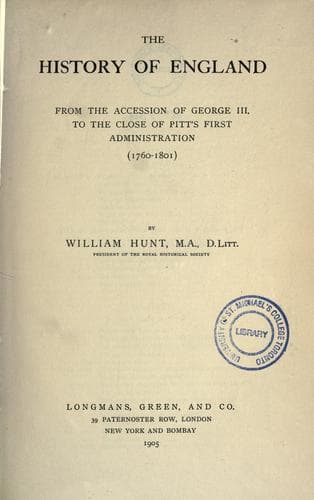
The history of England, from the accession of George III. to the close of Pitt's first administration, 1760-1801Hunt, William
History
The history of England, from the accession of George III. to the close of Pitt's first administration, 1760-1801
Hunt, William
Great Britain -- History -- George III, 1760-1820
George, who was sincerely anxious for the good government of the
country, desired, as a matter of general policy, to break down the power
of the undertakers, as he had broken down the power of the whigs in
England. He also had a special point to carry; he wanted to obtain the
consent of parliament to an augmentation of the Irish army from 12,000
to 15,000 men. As the peace establishment of Great Britain was only
about 17,000 men, the crown certainly needed a larger force, but it was
unfair to lay the burden of providing it on Ireland. With these objects
the ministry sent the Marquis Townshend, Charles Townshend's brother, to
Ireland as viceroy in 1767, ordering him to reside there throughout his
term of office. After much difficulty Townshend obtained the
augmentation, with the proviso that 12,000 troops should be kept in the
country, and the patriotic party, Lord Charlemont, Lucas, Flood, and
others, were gratified by the octennial act limiting the duration of
parliament to eight years. When the new parliament met, the commons
acting under the influence of the undertakers, renewed an attempt made
at the beginning of the reign to establish their authority over supply
by rejecting a money bill which, according to custom, had been prepared
by the government and returned by the English privy council. Townshend
prorogued parliament; and before its next meeting secured a majority by
wholesale corruption, such as had been employed in England by Fox and
Bute, and overthrew the power of the undertakers. His want of tact and
his indecorous conduct rendered his victory fruitless, and he was
recalled in 1772.
The general election of 1768 was even more corrupt than that of 1761.
Again both the court and the nabobs came well to the front.
Borough-mongers did a business in seats much as house-agents did in
houses. One of them laughed when Lord Chesterfield offered L2,500 for a
seat for his son; the nabobs, he said, had raised prices to at least
L3,000; some seats had fetched L4,000, two as much as L5,000. George
Selwyn took L9,000 for the two seats for Ludgershall. The city of Oxford
offered to return its two sitting members if they would pay the city's
debts, L5,670. They informed the house of commons of the offer, and ten
of the leading citizens were confined for five days in Newgate, and
afterwards knelt at the bar of the house and were reprimanded by the
speaker--a solemn farce, for they sold the seats to two neighbouring
magnates, and are said to have arranged the transaction while they were
in prison. Holland bought a seat for his second son, Charles James Fox,
then a youth of nineteen. As was natural in his father's son, Fox
supported the ministers, and was soon distinguished in parliament by his
opposition to all liberal measures, and outside it by reckless gambling
and extravagance.
[Sidenote: _WILKES RETURNED FOR MIDDLESEX._]
Public-domain text, read in full here on John Shaqi.
Reviews
Reviews
No reviews yet
Be the first to share your thoughts on this work.
Elsewhere in the archive
Join the Discussion
Join the discussion
Sign in to leave a comment or review.
Sign InorCreate an account