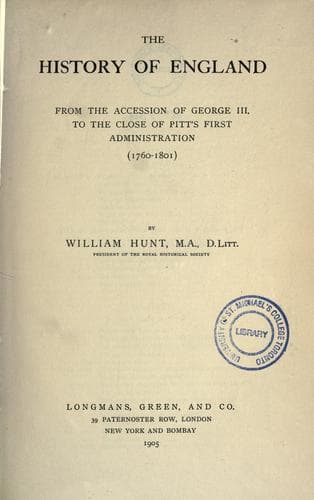
The history of England, from the accession of George III. to the close of Pitt's first administration, 1760-1801Hunt, William
History
The history of England, from the accession of George III. to the close of Pitt's first administration, 1760-1801
Hunt, William
Great Britain -- History -- George III, 1760-1820
The Irish house of commons was composed exclusively of protestants,
elected exclusively by protestants. Of its 300 members sixty-four were
returned for counties and were in some measure elected by the people.
Two were returned for Trinity College, Dublin. The remainder sat for
cities and boroughs, and of these 172 were nominated by borough-owners.
The duration of parliament was only terminated by the demise of the
crown. The house was the representative of the protestant aristocracy
and was completely out of touch with the mass of the people. It had
little control of finance, for the Irish establishments were large. The
civil list was burdened with pensions and sinecures, distributed either
as a means of parliamentary corruption, or among the supporters of the
castle policy and the hangers-on of the English court. By Poyning's law
the Irish parliament was subordinated to the English privy council, and
could not be summoned until the bills which it was called upon to pass
had received the assent of the council. A desire for greater
independence was growing up in parliament, and a patriotic party eagerly
pressed for reforms, for the extension of the _habeas corpus_ act to
Ireland, for securing the judges in office, and for shorter parliaments.
The government was in the hands of a party called the "Irish interest"
which worked harmoniously with the English ministers. Its chiefs, the
"undertakers," undertook the king's business in parliament, administered
the country, and dispensed patronage, for the lord-lieutenant only
resided in Ireland during the session of parliament, that is for six
months every other year. They answered roughly to the whig oligarchy in
England at the beginning of the reign, and in spite of some extravagance
and corruption used their power not altogether ill.
Public-domain text, read in full here on John Shaqi.
Reviews
Reviews
No reviews yet
Be the first to share your thoughts on this work.
Elsewhere in the archive
Join the Discussion
Join the discussion
Sign in to leave a comment or review.
Sign InorCreate an account