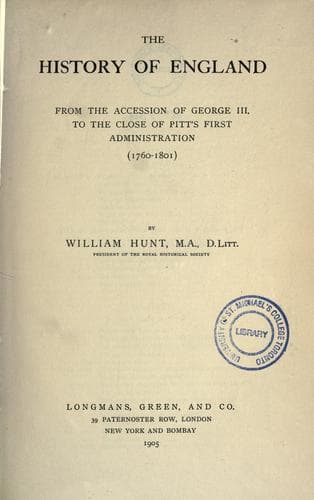
The history of England, from the accession of George III. to the close of Pitt's first administration, 1760-1801Hunt, William
History
The history of England, from the accession of George III. to the close of Pitt's first administration, 1760-1801
Hunt, William
Great Britain -- History -- George III, 1760-1820
A new writ was issued for Middlesex, and Colonel Luttrell, one of the
court party, resigned his Cornish seat in order to oppose Wilkes. In the
previous December at the election of Serjeant Glynn, Wilkes's counsel,
to the other seat for the county, one of his supporters lost his life.
Two men were found guilty of murdering him, and received a royal pardon,
for, though they assaulted him, the man's death was due to natural
causes. Luttrell was believed to be risking his life, and bets were
freely made as to his probable fate. The election, however, passed off
quietly on April 13, when Wilkes polled 1,143 votes and Luttrell 296. On
the 15th, the house, after a hot debate, carried by 197 to 143 a motion
that Luttrell "ought to have been returned". This decision, which set at
nought the rights of electors, was the inevitable outcome of the vote of
expulsion. The king was victorious, and was delighted at his victory.
His satisfaction was soon alloyed, for the means which he had employed
to gain his end roused widespread indignation. He had brought himself
into conflict with his people and had blunted his weapons. He had
gradually got together a set of ministers through whom he could rule;
for some of them were his willing instruments, and the rest, though
uneasy at their position, forbore to oppose him. At great cost to
himself and the nation he had secured a majority in the house of
commons, and he had strengthened his cause by enlisting on his side the
jealousy with which the house regarded all matters of privilege. Neither
his ministers nor the house failed him, not even when called upon to
violate the constitution, but his policy rendered both alike odious to
the nation. Wilkes was a gainer by his own defeat. Thousands who had
little or no sympathy with him personally espoused his cause when they
found it justly associated with liberty. A large subscription was made
for him: L17,000 was spent in paying his debts; his long-deferred suit
against Halifax was at last heard, and he obtained L4,000 damages; he
was again enabled to live in comfort, and while still in prison was
elected an alderman of London.
Public-domain text, read in full here on John Shaqi.
Reviews
Reviews
No reviews yet
Be the first to share your thoughts on this work.
Elsewhere in the archive
Join the Discussion
Join the discussion
Sign in to leave a comment or review.
Sign InorCreate an account