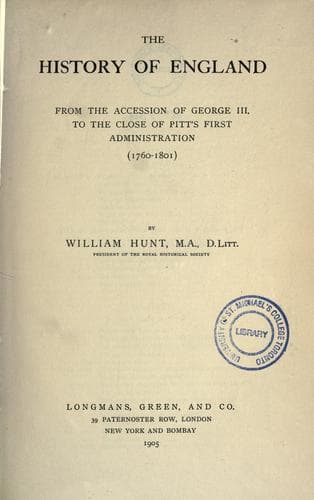
The history of England, from the accession of George III. to the close of Pitt's first administration, 1760-1801Hunt, William
History
The history of England, from the accession of George III. to the close of Pitt's first administration, 1760-1801
Hunt, William
Great Britain -- History -- George III, 1760-1820
Other causes contributed to the unpopularity of the ministers, among
them the French annexation of Corsica. The island rebelled against the
Genoese; and they, finding themselves unable to subdue it, agreed to
sell it to France. The bravery of the insurgents excited sympathy in
England; and there was a strong feeling that the acquisition of the
island by France would increase her naval strength, which was reasonably
regarded with jealousy. "Corsica," said Burke, "as a province of France
is terrible to me;" and Sir Charles Saunders, who had commanded in the
Mediterranean, held that to prevent the proposed annexation would be
well worth a war. There was, however, something to be said on the other
side. The ministers might have pursued either one of two courses. They
might have given France to understand that they would make the
annexation of the island a cause of war, and in that case France would
probably have drawn back; or they might, without loss of dignity, have
passed the matter by as no concern of theirs. Unfortunately, a decided
course was impossible to the divided cabinet. They remonstrated
vigorously, and France wavered. Then the Bedford section made it known
that England would not in any case go to war, and France despised their
remonstrance. Grafton allowed the Corsicans to hope for British help,
and secretly sent them arms. This was worse than useless. The Corsican
general, Paoli, was forced to flee; the island was annexed to France in
1769, and, as Burke said, "British policy was brought into derision".
[Sidenote: _ARREARS OF THE CIVIL LIST._]
Again, in the midst of the struggle with the Middlesex electorate,
parliament was asked for L513,500 to pay the debts on the civil list.
The civil list was sufficient to meet the legitimate expenses of the
crown; the king was personally frugal; how had the deficiency arisen?
Beyond all question the money had been spent in augmenting the influence
of the crown by multiplying offices and pensions, by the purchase of
votes at elections, and other corrupt means. The ministers were
responsible to the nation for the way in which the public money had been
spent. The opposition, and specially Grenville, Burke, and Dowdeswell,
urged that before the house made the grant, it should inquire into the
causes which rendered it necessary. Their demand was resisted: the house
decided not to consider the causes of the debts, and the ministers
carried the grant without inquiry. By this evil precedent the commons
abandoned the constitutional means of checking the expenditure of the
public money by the crown, and proved themselves unfaithful to their
duty towards the nation.
Public-domain text, read in full here on John Shaqi.
Reviews
Reviews
No reviews yet
Be the first to share your thoughts on this work.
Elsewhere in the archive
Join the Discussion
Join the discussion
Sign in to leave a comment or review.
Sign InorCreate an account