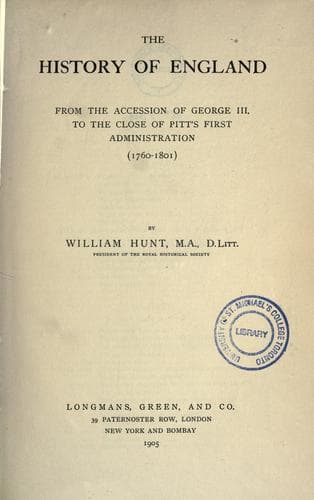
The history of England, from the accession of George III. to the close of Pitt's first administration, 1760-1801Hunt, William
History
The history of England, from the accession of George III. to the close of Pitt's first administration, 1760-1801
Hunt, William
Great Britain -- History -- George III, 1760-1820
Parliament met on January 9, 1770. It was a critical time: at home
discontent was widespread; the American colonies were disaffected; war
with France and Spain seemed not far off. The king's speech recommended
attention to American affairs and hinted at the unfriendly attitude of
foreign courts, but took no notice of domestic discontents, and gave
prominence to an outbreak of distemper among "horned cattle". The cattle
plague was a matter of serious national concern; yet the speech was
insufficient for the occasion; it was, Junius declared, the speech of "a
ruined grazier". It showed that the ministers intended to ignore the
signs of popular indignation. Chatham moved, as an amendment to the
address, that the lords would inquire into the causes of the prevailing
discontents and specially into the matter of the Middlesex election.
"The people," he said, "demand redress, and depend upon it, my lords,
that one way or other they will have redress;" and he attributed their
discontent to the action of the commons in Wilkes's case. Camden
followed, and declared that he had beheld the arbitrary acts of the
ministry with silent indignation, that he would no longer keep silence,
and was of the same opinion as Chatham. Mansfield opposed the amendment
on the ground that it infringed upon the right of the commons to be sole
judges of elections and might lead to a quarrel between the two houses.
Chatham said that he reverenced the constitutional authority of the
commons, but they had gone beyond it, they had betrayed their
constituents and violated the constitution. He ended with a declamation
exhorting the peers to act as became descendants of the barons of Magna
Charta (how many of them could trace descent from so noble a source?)
and like "those iron barons, for so," said he, "I may call them when
compared with the silken barons of modern days," to defend the rights
of the people at large. His amendment was negatived. The address was
carried in the lords by 203 to 36, and in the commons after a hot debate
by 254 to 138.
Public-domain text, read in full here on John Shaqi.
Reviews
Reviews
No reviews yet
Be the first to share your thoughts on this work.
Elsewhere in the archive
Join the Discussion
Join the discussion
Sign in to leave a comment or review.
Sign InorCreate an account