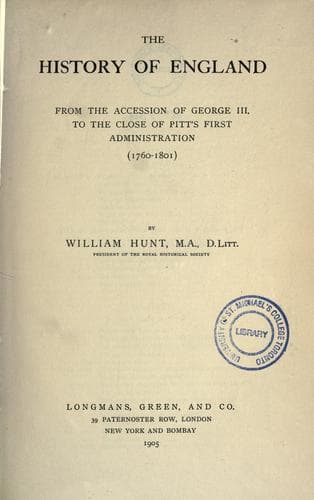
The history of England, from the accession of George III. to the close of Pitt's first administration, 1760-1801Hunt, William
History
The history of England, from the accession of George III. to the close of Pitt's first administration, 1760-1801
Hunt, William
Great Britain -- History -- George III, 1760-1820
Camden's conduct was discreditable. It is true that the maxim that a
member of the cabinet should either acquiesce in the decision of the
majority or resign his seat in it, was not then universally accepted,
and that Camden had made it plain that he disapproved of the policy of
his colleagues with respect to the vote of incapacity. He had not,
however, opposed it with any show of determination. His alliance with
Chatham made it certain that he could not retain the chancellorship, yet
he would not resign it, because he could inflict a harder blow on the
ministry as a member of it than he could when out of office. Decency
demanded that he should resign before he appealed to the lords against a
decision made by the cabinet in which he sat. He was dismissed from
office on the 17th. Granby at once threw up the ordnance and the command
of the army, and Dunning, the solicitor-general, and some others also
resigned. It was difficult to find a new chancellor, for the ministry
was believed to be moribund. Grafton offered the great seal to Charles
Yorke, the second son of the famous chancellor, Hardwicke, who died in
1764. He had twice been attorney-general, and was an ambitious man. His
brother, Lord Hardwicke, and Rockingham, to whose party he had attached
himself, urged him not to accept the offer, and he declined it. On the
17th, George told him that if he did not accept the great seal then, it
should never be offered to him again. He yielded, and his brother and
Rockingham reproached him bitterly for his compliance. He was in
ill-health and his malady may well have been increased by his agitation.
In any case, he died on the 20th, perhaps by his own hand. His death
defeated Grafton's one hope of strengthening the administration; he had
no one in the cabinet on whose support he could rely except Conway; for
Weymouth and the rest constantly acted contrary to his opinions. He
resigned office on the 28th.
[Sidenote: _THE KING'S POLICY SUCCESSFUL._]
Public-domain text, read in full here on John Shaqi.
Reviews
Reviews
No reviews yet
Be the first to share your thoughts on this work.
Elsewhere in the archive
Join the Discussion
Join the discussion
Sign in to leave a comment or review.
Sign InorCreate an account