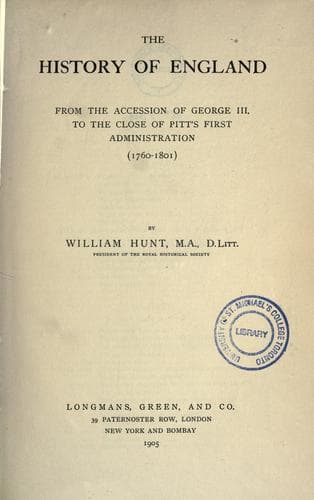
The history of England, from the accession of George III. to the close of Pitt's first administration, 1760-1801Hunt, William
History
The history of England, from the accession of George III. to the close of Pitt's first administration, 1760-1801
Hunt, William
Great Britain -- History -- George III, 1760-1820
The violent language employed by the newspapers on the opposition side
laid them open to reprisals. Constant resort to indictments by the
attorney-general, and the exception of seditious libels from privilege
of parliament, indicate the desire of the king's party to treat press
offences in a special way. They were gratified by a ruling of
Chief-justice Mansfield in the case of Almon, a bookseller, who was
tried on an _ex officio_ indictment for selling Junius's _Letter to the
King_. Mansfield laid down that in cases of libel the jury could only
deal with the facts of printing and publishing; it belonged to the judge
to decide the character of the statement. This was not a new doctrine;
it had been declared and acted upon by many earlier judges. The
newspaper press, however, had by this time become important, and
Mansfield's ruling infringed on the liberties of those engaged upon it,
for, while that was the law, a man after being indicted by the
attorney-general, who held office by, and at the pleasure of the crown,
was deprived of his right to be judged by his peers on the substantial
point at issue. Indignant juries refused to convict in libel cases, and
Mansfield's ruling was attacked by the opposition in parliament. Chatham
and Camden denied its legality. In the commons, though a proposal to
abolish _ex officio_ informations received little support, a motion for
a committee of inquiry into the rights of juries was only defeated by
184 to 176. Dowdeswell and Burke believed that the question of law was
likely to hinder a satisfactory settlement, and in March, 1771,
Dowdeswell moved for an act to give juries the powers denied to them. A
section of the opposition, however, held with Chatham and Camden that
the matter should be settled by a bill declaring that the law gave them
these powers. They would not support the motion, which was lost by an
overwhelming majority; and Mansfield's ruling was received as law until
1792.
[Sidenote: _HOUSE OF COMMONS AND THE PRINTERS._]
Public-domain text, read in full here on John Shaqi.
Reviews
Reviews
No reviews yet
Be the first to share your thoughts on this work.
Elsewhere in the archive
Join the Discussion
Join the discussion
Sign in to leave a comment or review.
Sign InorCreate an account