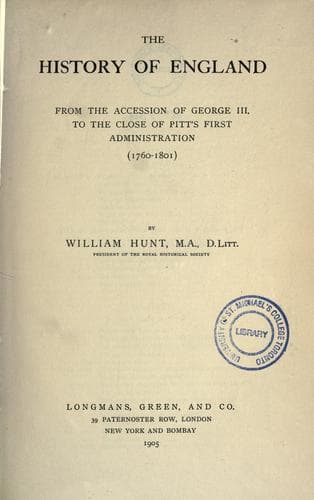
The history of England, from the accession of George III. to the close of Pitt's first administration, 1760-1801Hunt, William
History
The history of England, from the accession of George III. to the close of Pitt's first administration, 1760-1801
Hunt, William
Great Britain -- History -- George III, 1760-1820
Another matter connected with the press engaged the house of commons for
the most part of the remainder of the session of 1771. Parliament, as
we have seen, was so constituted that occasions might and did arise on
which the will of the people was not fairly represented. This
constitutional difficulty was increased by the secrecy in which
parliament shrouded its proceedings. Once useful as a means of securing
freedom of debate, this secrecy was maintained as a matter of privilege
after it had become useless and, indeed, pernicious. It was carried to
an extreme point by the present parliament, the "unreported parliament"
as it was called. Strangers were constantly made to withdraw from both
houses, specially when a popular member of the opposition rose to speak.
This caused a silly quarrel between the two houses in 1770, and either
shut its doors against the members of the other. The publication of
reports, forbidden by a standing order of 1762, had for some time been
carried on under various disguises, and the reports, which were founded
on scanty information, were often unfair and scurrilous. In February,
1771, Colonel Onslow complained of two newspapers which misrepresented
his conduct in the house, and held him up to contempt by describing him
as "little cocking George". Disregarding a warning from Burke as to the
folly of entering into a quarrel with the press and attempting to keep
its proceedings from the public, the house ordered the printers, Wheble
and Thompson, to attend at the bar. The serjeant-at-arms failed to find
them, and was jeered at by their workmen. A proclamation was then issued
for their arrest. While this affair was pending several newspapers
commented on the proceedings of the house, and attacked various members,
and specially Onslow, describing him as "a paltry insignificant insect"
and so on. On March 12 he moved to proceed against six other printers.
The opposition, led by Dowdeswell, Burke, and Barre, made a determined
stand. They divided the house twenty-three times, and it sat till 5 A.M.
"Posterity," said Burke, "will bless the pertinaciousness of that day."
Onslow's motion was carried; some of the printers were reprimanded, one,
Miller, refused to attend.
Public-domain text, read in full here on John Shaqi.
Reviews
Reviews
No reviews yet
Be the first to share your thoughts on this work.
Elsewhere in the archive
Join the Discussion
Join the discussion
Sign in to leave a comment or review.
Sign InorCreate an account