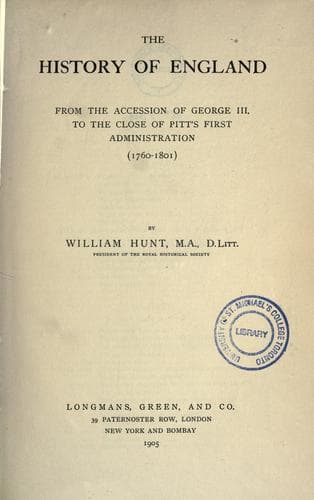
The history of England, from the accession of George III. to the close of Pitt's first administration, 1760-1801Hunt, William
History
The history of England, from the accession of George III. to the close of Pitt's first administration, 1760-1801
Hunt, William
Great Britain -- History -- George III, 1760-1820
The strength of the ministry caused a stagnation in matters of domestic
policy, and parliament turned its attention towards a settlement of the
government of India. In 1772 the East India Company was on the verge of
bankruptcy, owing chiefly to expensive wars, large pensions to native
rulers, and the greed of the proprietors. The successes of Haidar in the
Karnatic and the famine in Bengal sent down the price of stock, as we
have seen, 60 per cent. The company applied to government for a loan of
at least L1,000,000. North, with statesmanlike decision, seized the
opportunity of asserting the right of the crown to the territorial
revenue and of placing the government under the control of its
ministers. The king upheld his policy. Select and secret committees were
appointed by the commons to inquire into the condition of the company
and of the British affairs in India. Acting on the recommendation of the
secret committee, North foiled an attempt of the company to keep its
affairs in its own hands by carrying a bill to restrain it from
appointing supervisors in India. Burke violently opposed this and every
step by which the territorial power of the company was brought into
subjection to parliament. It was, indeed, with some justice that he
urged that the violation of the royal charter held by the company was a
dangerous precedent, that the claim to the territorial revenue was
arbitrary, and that parliament had increased the company's distress by
extorting from it the payment of L400,000 a year, and had done nothing
for it in return. The case for the company was supported in both houses
by the Rockingham party generally.
Public-domain text, read in full here on John Shaqi.
Reviews
Reviews
No reviews yet
Be the first to share your thoughts on this work.
Elsewhere in the archive
Join the Discussion
Join the discussion
Sign in to leave a comment or review.
Sign InorCreate an account